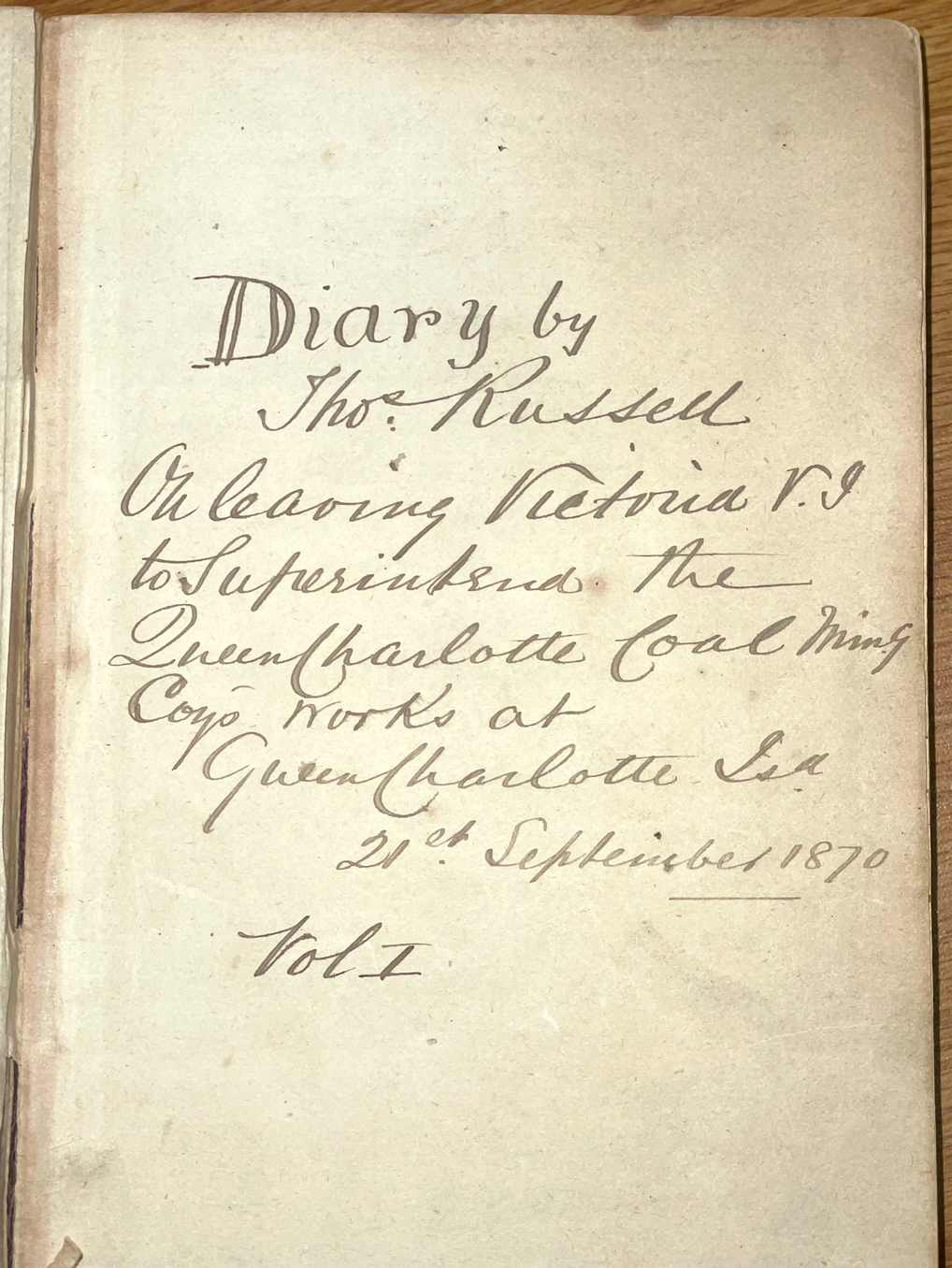
Volume I
For a map of Sloop Thornton route discussed in Volume I see Volume I - Passage of the Sloop Thornton from Victoria to the Queen Charlotte Islands (now called Haida Gwaii).
Introduction
There are few readier means of attacking the testimony of a traveller than to point out that he tells improbable stories; things not perhaps physically impossible, but unfamiliar to the critic’s experience and therefore not set down by him in the catalog of likely incidents.
This kind of criticism, however, has the serious fault of going hand in hand with ignorance. The less the critic knows of the world, the more things of course seem unlikely to him and in the long run his assult [sic] is apt to strengthen the very evidence it was directed against.
I will not, however, trouble myself longer about such criticism or critics. This little diary is intended for the eye of one critic only, and that critic is my dear wife. For her amusement alone shall the following pages be written, and the interest she will take in perusing them will more than repay me for my small efforts.
As I now write, I feel rather gloomy, fearing that these pages will lack incident to make them interesting. When a man writes a book and takes certain character for the foundation of the tale he can crowd or lessen incidents at will, but in a diary where
“stern truth and not fiction”
must be embraced, the writer is entirely at the mercy of what the day may bring forth, but should one page lack incident and the other be too crowded make them a set off for the other.
Thomas Russell
Sloop Thornton
21st September 1870
Wednesday 21st September 1870
Whoever hath parted from a loving wife and children for a distant land isolated from the habitations of civilized men will fully understand my feelings this morning, but those who live in this world for themselves only and hath not such dear ties to leave behind them could not understand, no matter how much I might explain.
Left my wife and home at 3:00 o’clock AM. Went down to the Sloop Thornton, found all on board fast locked in the arms of Morpheus. Roused up the captain. Having completed his toilette, which did not occupy more than 5 minutes, he said he would go and call Mr. Warren who is the owner of the vessel. In the meantime he instructed the chief mate to get some coffee ready by the time he returned. I accompanied the captain to the house of the owner, which by the way is not a stately mansion, but what is vulgarly termed a shanty, with one room and a kitchen. We roused him up and then returned to the sloop, to find hot coffee awaiting us.
Now I dare say at any other time and under different circumstances the coffee would have been very acceptable, but this morning I had quite lost my appetite. At 4:00 o’clock the three white men came on board, the Chinamen having slept on board that might be ready for a start. There appeared to me to be a great deal of time wasted in looking at this and trying that, until 5:00 o’clock when we pushed off from the wharf with just sufficient wind to keep the sails spread. We were two hours in making Clover Point.
Mr. R. Fawcett came down to the point and waved an adieu. Quite a number of whales were sporting about. The wind was dead against us and very light so that as one might term it we were just crawling along; the breeze freshened towards noon but still in our teeth.
Saw nothing worthy of note, but had ample time to study the physiography of my companions. Before going further, I will say something about the men who are to be my companions on Queen Charlotte, their respective names are as follows; Laiken, Riely, Beauchamp and three Chinamen Ah Chee, Ah Hen and Ah Loy.
Laiken is an Englishman and a coal miner by trade. I should judge from his appearance that he is a quiet steady industrious simple unassuming man, but from his conversation he evidently considers himself number one at mining; perhaps he may, but that has yet to be proved. The only thing that I dislike about the man are his long winded yarns: he bores you to death with minutiae, he talks about things very well calculated to amuse and pass away the hours. He is a married man and has a family in Victoria. This fact I think makes me feel more kindly toward him than I otherwise would have been.
Riely is a son of the Emerald Isle; there is something more in his composition than in Laiken’s. I find him continually watching me when he thinks I am not looking at him, but I believe he is getting paid back in his own coin. It would be impossible for me, under the circumstances of our meeting, to form a very good opinion of him. You must know that two days before we started, and after he had been engaged by the company, he was taken up and lodged in prison for selling whiskey to an Indian, for which crime Pemberton in all probability would have given him six months in the chain gang. Mr. Gaston, hearing of this, saw Pemberton and told him that he was under an engagement to go to Queen Charlotte Island and begged of him to let him go - to which he consented provided that a policeman should put him on board and see him fairly started; so that when he was brought down in charge of Sergeant McMillen I almost felt inclined to look upon him as a convict in my charge, to be safely deposited on the distant island of Queen Charlotte and there kept at work coal mining for the space of six months. Knowing that he will appear again in these pages, I will leave him for the present.
Beauchamp is an old French Canadian, and an old settler here. He is known to you in name if not in person. He is the same old stick and full of drollery, but sadly the worse for wear; time and whiskey has told a sad tale.
The three Flowery Kingdom gents are like all other Chinamen. Not easily understood - and I don’t think I will try to understand them further than see that they do their duty properly.
To comment upon the crew of the sloop would perhaps be an unwarrantable license. Her regular crew consists of a captain, chief mate and an Indian, but this trip the owner Mr. Warren being with us they have dispensed with the services of the Siwash. Asquarto render the chief mate, who is a little Frenchman, usually acts as a cook on other trips I thought I would let him have a holiday and therefore turned in our Chinaman cook to take his place, which appeared agreeable to all hands and particularly so to the little Frenchman. Mr. Warren is a Canadian, resembles Bill McDougal very much both in appearance and manners. The captain (Mr. Brown, better known on board as George), is to my mind the best of the three. He is an Englishman and evidently had a fair bringing up, but like all other seafaring men a little rough. I have some sort of fancy that I shall like the man; he appears to have no very great peculiarities about him.
It is now 4.30 o’clock PM the wind is dying away and the tide has changed that is to say begun to ebb and therefore against us. 5.15 o’clock PM finding we are not making any headway against the ebb we cast anchor off Sidney Spit, about 25 miles from Victoria.
8:00 o’clock I have been walking the deck for the past hour and have just come below for the evening. Our cabin is very small, about 8 feet square with two bunks on each side. The one allotted to me is not lettered P at the bottom of the stairs, but nevertheless it is at the bottom of the stairs. Goodnight; here goes for the bunk for a season.
Thursday 22nd September 1870
Got up at 6 this morning, not a breath of wind anywhere, the sea almost motionless;
To breakfast at 7, felt quite equal to a good meal and I did ample justice to the beef steak and potatoes. I don’t remember to have eaten such a meal at any time before, in fact I ate so much that I feared they would put me down for a glutton. The ebb tide was still running, and here we must remain until it changes.
10:00 o’clock AM weighed anchor, tide with us and a light breeze blowing against us. It is very hot on board today; we are just crawling along. Oh dear, this is horrible tiresome work. I feel as if I could jump overboard and push her along. I have no heart for writing today; incidents none, dreary weary work, wind fast dying away and the tide will soon be against us.
2:30 PM entered Plumper Pass, dead calm, tried to pull into a bay in the Pass to anchor, but before we could manage it the ebb began and drove us back outside of the Pass where we cast anchor at 4:00 PM. This kind of work is enough to make one swear, but since that will not help us along I will refrain. My dear Sol asked me not to become wicked and swear, therefore I will only say
“enough to make one swear”.
Salmon are jumping about in dozens, but neither hook nor line have we to catch any.
From this point we can see the farm and house which belonged to the poor little old tinker who was murdered some months past. You remember the poor old man who used to come round, mending pots and pans. The dog that belonged to him came around the bay and barked at us. My appetite still keeps strong; I feel as though I could take a meal every hour, but instead I eat a cracker and go to bed.
Friday 23rd September 1870
About 4:00 o’clock this morning I was awoke by someone going up the ladder, saying as he went that he had put his shoulder out of joint, but I fancy it seemed rather queer that a man with his shoulder out of joint should be talking about the affair so unconcernedly. Thinking I must have been dreaming, I turned over and fell asleep.
6:00 o’clock got up, partially dressed myself and went on deck to wash when lo! and behold! there sat old Beauchamp with his shoulder out, sure enough. As a matter of course I asked him how he had met with such an accident, which happened as follows: it appears that between 3:00 and 4:00 o’clock he was getting out of bed to go on deck and in doing so struck his shoulder against a box which caused it to dislocate, but he said it was nothing - it could very easily be put in again provided anyone on board knew how. Not being skilled in such matters I handed him to the captain who tried for nearly an hour but only succeeded in giving him pain. Laiken tried next but with no better result. Warren tried next but all to no purpose. Seeing that there would be no chance for him to get his shoulder put in on board, I told the captain to run into Nanaimo. Accordingly, we weighed anchor at 8:30 and headed for that place.
It was not our intention to go to Nanaimo had everything gone right, but to have entered the Gulf of Georgia by Plumper Pass.
This has been a fearful day, dead calm, only drifting with the tide and a man on board in distress. Had we sighted a canoe I should have sent him on, but none made their appearance.
5:00 o’clock PM tide has changed, and we have to drop anchor off Long Island, only making about 12 miles today - enough to make one go mad. 6:00 o’clock I had a try at the shoulder, but in it would not go so the only consolation I could give him was that he would have to await time and tide.
Saturday 24th September 1870
Everybody seems to have the “blues” this morning—no wind and old Beauchamp in pain. The old man has quite changed; tried to get a joke out of him, but no, not even a smile. 9:00 o’clock AM light breeze struck up, weighed anchor and prayed for more wind.
This is a charming day, the sun shining in all his glory and our little craft moving steadily forward. The breeze, however, is not strong enough to make her wash her prow. 3:00 o’clock PM wind dying away and we are yet some distance from the Rapids. 5:00 o’clock arrived at the mouth of the Narrows. Tide running very strong against us, consequently we had to anchor and await the turn of the tide to carry us thru. The captain thought to make a start about 12:00 o’clock.
8:00 o’clock went on deck, fancied by the appearance of the current the tide would change soon; suggested that we had better lower the boats and put into the Rapids to ascertain, which we did, and found that it would be safe to start about 10:00 o’clock, which we did. We had to pull her through the Narrows with the oars, after which we had just sufficient wind to make her steer. Very cold on deck tonight. Made some coffee at 12:30 o’clock which was very acceptable. Remained up until about 2:00 o’clock; I was anxious to wait until we had reached Nanaimo, but it was rather cold for me. Anchored in the mouth of Nanaimo Harbour at 3:00 o’clock AM.
Sunday 25th September 1870
Got up at 6:00 o’clock this morning, took breakfast and then went on shore with Beauchamp. Knocked up the doctor. He came to the door in his shirt and pants; he let us in and in 15 minutes Beauchamp’s shoulder was in its proper place. The moment the joint went in he laughed—the first time for two days. Whilst this was going on I was writing a letter to my sweetheart which the doctor promised to post for me on the morrow. Paid him $5 and bade him good morning.
Took a fresh supply of water off with us, got up the anchor and stood across the Gulf of Georgia with a strong breeze in our favor. This is my first Sunday from home and the only day I may say that we have had any wind. The sloop thundered and flew over the sea. I knew and felt that she was conveying me away from all I love, and gazing over the side and astern I really did shed a silent tear. The morning was clear; white clouds chased by the morning wind flew across the deep. The waves beat foaming against the vessel; the autumnally beautiful forest extended to the left as far as the eye could see.
Such mornings as these bring out man’s better feelings. 10:45 o’clock AM I am now thinking that my darlings are on their way to the House of God, and I shall allow myself to feel as though I am with them. Sunday on board here looks just like any other day except that the men don’t play cards, but Mr. Warren—because he can’t get the others to play—is playing by himself.
The sea is now quite rough; the men are all below seasick. One of the Chinamen has been up vomiting, and what an object of pity he looks. I don’t feel the slightest symptoms of sickness and I don’t think I shall be sick no matter how much she may toss and tumble.
Only the crew of the vessel and myself took dinner today. Laiken got up and took two potatoes and a small piece of meat on his plate. He went on deck with it, but could not get the first mouthful down; consequently he came below again and went to bed.
6:00 o’clock PM sighted Cape Lazo. We are now abreast of Hornby Island, the wind decreasing very fast. 7:00 PM sighted the place on Hornby Island where Dawson has taken up his whaling quarters, great volumes of smoke rising. I presume they are frying out the oil. 8:00 PM dead calm and the sea has quietened down; the men are coming out of their shells looking for food.
We have made more progress today than all the others put together. A few days of such wind as we had today would soon bring us to our destination. The whales appear to be very numerous in the gulf; wherever you gaze you can see them blowing, sometimes quite close to us.
Monday 26th September 1870
Came on deck at 5:30 o’clock AM. Light breeze in our favor. Comox on our port bow. 9:00 o’clock breeze gone and here we are tossing about; weary dreary work.
Riely has been complaining of earache since we left, but it appears to be turning to something worse than a simple earache. It is now very much swollen behind the ear, and the pain increasing. Advised him to poultice it, which he has done, but derived no benefit therefrom. He has got some Russian salve which he is applying to the interior of the ear. I think it must be gathering, and if so, he will get no relief until it breaks.
Afternoon, no wind and yet no appearance of any. Nothing worthy of note; plenty of whales but nothing else. Going early to bed tonight.
Tuesday 27th September 1870
Light breeze during the night. Sighted Cape Mudge at daybreak. This is a beautiful clear morning.
We are now approaching the most dangerous place in the whole voyage. The tides meet at this point causing a terrible Tide Rip, and in blowing weather very dangerous for small craft; but we are thankful that the wind is very moderate.
Perhaps you don’t understand what I mean by the meeting of the tides. I will explain. Cape Mudge is at the entrance to Discovery Passage, which is in reality the entrance to Johnston Strait. Now this strait divides Vancouver from British Columbia and runs NW–SE, opening into the Pacific at the northwest point of Vancouver and at the east into the Gulf of Georgia at Cape Mudge; so that when the tide flows it turns northwest up Fuca Straits and SE through Johnston Strait, meeting together near Cape Mudge in the Gulf of Georgia, and acts just in the same way that two buckets of water would when poured into a trough from opposite ends, when it would meet in the middle and cause a great commotion.
7:30 o’clock AM entered Discovery Passage. There are dogfish by thousands here; the water is perfectly alive with them.
9:30 o’clock sighted the schooner Carolina lying at anchor in Duncan Bay (this bay is about midway between Cape Mudge and the Yokota Rapids). Ran into the bay and came to anchor to await a suitable period of the tide to go through the Rapids. These Rapids run so strong that it is dangerous to go through them except at the change of the tide, and not knowing the exact state of the tide the captain thought it better to anchor and see how the tide was and when it would suit.
Went on board the Carolina. She has been 12 days out from Victoria; she was becalmed 3 days in the Gulf. The captain of her is a hard-looking case. I believe him an Indian whiskey seller and that he has got a good supply on board. We learned from him that the tide would suit us to run the Rapids at 7:00 o’clock tomorrow morning.
Went ashore, took the Chinamen and got a fresh supply of water from a small stream at the head of the bay. The footprints of wolves are quite plentiful on the banks of this stream. Pulled round the bay this afternoon fishing for salmon, but didn’t even get a nibble although hundreds of them are jumping about.
Wednesday 28th September 1870
Got up at 4:00 o’clock AM and weighed anchor at 5:00; the Carolina got the start of us by 20 minutes. The wind is very light, but we are moving on slowly. Entered Johnston Strait at 8:00 o’clock. The rapids were running very strong. One of the whirlpools caught the vessel and carried her round three times. Strong breeze blowing from the N.W. Passed the Carolina at 8:30 o’clock; we are doing pretty well considering we have a head wind to contend with.
3:00 o’clock PM reached Ripple Point. The wind slackened and tide against us; ran back about a quarter of a mile and anchored behind a small island. 5:00 o’clock PM tide changed, got up anchor and stood into the strait. The wind is increasing, but very unsteady—in fact quite squally. Took the gaff topsail off her.
11:00 PM wind died away; strong tide rips here, making the vessel almost unmanageable. Midnight called the Chinamen up and put them on the oars, and after an hour and fifteen minutes pull reached the mouth of Salmon River where we anchored for the night—and glad I was when we had got the anchor down. I felt rather uneasy all the time she was running. The Strait is very narrow here and there are a great many drift logs about. Went to bed very tired.
Thursday 29th September 1870
This morning we got up a little late; very little wind. There are a number of the Yakulta Indians camped at the mouth of Salmon River fishing salmon. Two canoes came alongside; we bought some salmon from them, and I assure you they are quite a treat as we are now living on salt meat.
The mountains near this river are very high, but the height not marked on the chart. There is no snow on the summit of them, but their northern sides are quite white. 7:45 o’clock weighed anchor; delightful morning, not a cloud to be seen, but very cold.
Riely’s ear is no better, in fact I believe much worse. It disturbs his rest and makes him feel quite miserable. 10:00 o’clock AM sighted the entrance to Adams River. Mount Palmerston is a beautiful sight on such a day as this, its snow-capped peak glistening in the sun is really something grand. This mountain is 5000 feet above the level of the sea and is on the southwest side of Adams River.
2:00 o’clock wind gone and tide against us; ran in shore on British Columbia side and tied up alongside the rocks. This is dreadful travelling; I am beginning to think it will take us a month in making the trip. From the want of something better to do, I made a draught board this afternoon and played a game with the captain and beat him.
5:00 o’clock weighed anchor, tide in our favor. 7:00 o’clock raining and the wind rising, but in our favour. It is very dark and thick tonight. Mr. Warren thinks it won’t be very safe to run all night, so we have headed for Adams River.
Reached the river at 9:00 o’clock; very dark. I was heaving the lead while the others were guiding the vessel and keeping a lookout. Let go the anchor in 10 fathoms water, but it appeared the bank must be very steep, for when the vessel swung back on her anchor it slipped and before we could do anything ran out about 15 fathoms more chain. The captain would not try to anchor there again, so we hoisted the anchor in and stood out again. 10:30 o’clock wind shifted to the S.W., very squally, and the rain pouring down. Did not go to bed until the wind moderated, which was about 1:00 AM.
Friday 30th September 1870
Got up this morning about 6:30 o’clock; no wind and raining very hard. We are drifting up with the tide. This cabin is a miserable den in raining weather. All the cooking having to be done, it parboils one if you remain an hour in it, and if you go on deck you get drenched. These are the days that make me sigh for home. I wish I was there with somebody’s arms around me.
12:00 PM tide changed so we tied up on Vancouver shore near Blinkhorn Island. This island is in Latitude 50° 33” North and Longitude 126° 50’ West. We are now 10 days out and only sailed about 220 miles—only halfway on our voyage.
4:00 o’clock PM rain cleared off, light breeze sprung up. Got underway, but the wind only lasted an hour when a thick fog set in. Tried to make Beaver Cove to lay up for the night, but couldn’t for the tide. Ran across to B.C. shore and anchored in a narrow pass between two small islands to the northeast of Weynton Passage at 7:00 o’clock.
Saturday 1st October 1870
Got up this morning before the sun—and a lovely morning it is. Immediately opposite us is Mount Holdsworth, 3040 feet high. This mountain lies to the west of Beaver Cove. I watched the first rays of the rising sun on its peak; it shone as though it had been clothed in gold instead of timber.
Fair wind springing up. Weighed anchor at 7:00 o’clock, wind freshening from the N.E. All sails set; the vessel is going faster this morning than I have yet seen her. 9:15 o’clock AM abreast of Nimpkish River. A canoe with Indians came off and tried to reach us, but no use. This is the kind of weather; she is gliding through the water like a fairy.
1:30 o’clock abreast of Fort Rupert. We have made a good run this morning, but the wind is slackening. We have now entered Goletas Channel which opens into the Pacific at the N.W. corner of Vancouver, and should the breeze hold up we will say goodbye to its dear old shores tonight.
8:45 o’clock PM entered Chadwell [sic] Passage and passed the wreck of the Swannee [sic], part of her hull and paddle boxes still remain on the rock. Beautiful moonlit night; we are now in Queen Charlotte Sound.
Mr. Warren thinks it’s safer to run across and make for the inside passage instead of steering straight for Queen Charlotte. We expect to sight Cape Caution about 1:00 o’clock AM. Remained on deck and kept a lookout forward until 12:00 o’clock when the Chief Mate and Mr. Warren came on deck and relieved us. The men don’t seem to care a button how things go; all they care about is to be up in time for breakfast and go to bed after supper.
Sunday 2nd October 1870
This morning I expected to find the vessel safe in the inside passage, but no—we are still in Queen Charlotte Sound. Mr. Warren said that the Captain and I had passed the mouth of the channel during our watch and that we were now heading for Milbank Sound. Nearly a dead calm this morning with a heavy swell on. We have made a good run since yesterday morning—nearly 100 miles, the best sailing we have done yet. The men are rather squeamish. Barometer falling very fast and black clouds gathering up; it looks as though it might blow sometime during the day.
This is my second Sunday from home, and to tell the truth I am more homesick than ever. Sundays spent after this fashion do not suit me very well, and more especially when tumbling about in this heavy swell; but I hope, God willing, to be on dry land by next Sabbath.
3:00 o’clock PM we are now abreast of Milbank Sound and heading for Point Day, which point we have to round in order to get into Laredo Passage. Wind about the same, very light. This is a very rugged coast. Point Day is a fearful looking place, large rocks running about two miles out to sea.
7:00 PM raining and rather inclined to be squally. 8:00 o’clock blowing a gale and very dark; we are now heading for the passage. 10:30 o’clock pitch dark, rain falling in torrents and blowing great gusts. Mr. Warren ordered the vessel to be hove to for the night, as he could not well see the entrance.
Monday 3rd October 1870
I feel truly thankful for having been spared and protected through the perils of last night. I will begin to record where I left off last night. About fifteen minutes past eleven it seemed a little clearer and Warren ordered the jib to be hoisted and stand in for the land. He said he thought he could see the opening to the passage. After a half hour run we got into the place which he thought was the channel, but it proved to be no channel at all, but simply an opening between the rocks.
It is almost impossible for me to describe our perilous position; the sea was running mountains high and the breakers on every side of us; in fact we were in surf. The water was perfectly white and appeared in a blaze. The wind almost died away, or rather I presume the rocks sheltered us. Mr. Warren tried the lead and found nine fathoms of water. He wanted to let go the anchor, but the Captain would not let him. He said from the way she was pitching in the heavy sea she would snap the chains like cords.
We tried to run out to sea again and shook the reefs out of the sails, but to no purpose. There we were driving about, not knowing but we might be dashed on the rocks any moment. In fact I gave up all hope of her getting out of it, and about 1:00 o’clock took off my coat and boots to be prepared for her striking. Whilst I was below doing this she nearly struck; it was a miracle she escaped. They were trying to put her round when she missed stays and I heard the Captain cry out,
“Wear her quick or she is gone,”
but God be thanked we escaped. A little wind struck up and blew her off.
The wind freshened a little and we got out of our perilous situation about a quarter to 2:00 o’clock. We ran out to sea about four miles and hove to, to await daylight.
During the whole of the time we were in amongst the rocks all the men were in bed except Riely, who appeared very anxious. I wanted him to come on deck and help us, but he was afraid of being washed overboard.
Daylight began to break about 5:30 AM and the wind and sea had moderated considerably. We could now see that the place we had tried to go through was dangerous beyond all description. Mr. Warren said he was completely at a loss to say where we were. He proposed therefore to run through a narrow pass to the southeast of us hoping to find the inside passage. Accordingly we stood in.
This has been a beautiful morning, very little wind, but we have been moving steadily on, and finally came into the proper channel above Bella Bella.
Mr. Warren made a great mistake on Sunday; it appears that the place we thought was Milbank Sound was a deep bay some thirty miles distant from Milbank, and the point he took for Point Day a reef of rocks extending about four miles into the sea. Such mistakes as these shake my confidence in him. We are now running up for Milbank Sound and not wishing such another night as we had last. He proposes to anchor before dark.
2:00 o’clock PM spoke to the steamer Otter bound for Victoria. 3:00 o’clock cast anchor in a bay near the entrance of Milbank Sound.
Tuesday 4th October 1870
Got under weigh [sic] this morning at 5:00 o’clock, good breeze blowing in our favor. Blowing a gale with a tremendous sea running. 9:00 o’clock shortened sail. This is the heaviest sea and wind we have had yet, coming on very thick.
Rounded Point Day at 10:45 o’clock. The breakers are running over this point about forty feet high; it is a beautiful sight, but not very pleasant to be very close to it. 11:00 o’clock shortened more sail. The little sloop is behaving like a well broke horse; she is perfectly flying, and the heavy seas washing her decks.
12:00 o’clock entered Loredo Channel; the water is a little smoother in here. 1:50 o’clock PM made more sail. We expect to make a good run today if all goes well.
3:30 o’clock very thick fog and rain pouring down in torrents; consequently we ran in to the mouth of a small creek and came to an anchor.
Wednesday 5th October 1870
Got up anchor at 6:30 AM. Strong breeze blowing from the S.E. and raining. Clapped on every stitch of canvas; we are sailing at about eight knots per hour. 8:30 shortened sail. It is now blowing quite a gale and we are near the head of the channel where it opens into the sea.
10:00 o’clock wind has increased to a perfect hurricane and raining bucketfuls. Men and Chinamen all in bed seasick. 11:30 we have at last crossed the opening between Laredo and Principe Channels and have entered the latter channel; this channel divides Banks Island from the Mainland.
We are under double-reefed sails and she is rolling about like a nutshell. We are keeping a sharp lookout for some snug bay that we may run in and anchor. The Captain thinks this is only the beginning of the storm.
12:00 PM a number of Indians camped on Banks Island fired guns to attract our attention, but the place where they were was so exposed that we dared not anchor in it. 12:30 a heavy fog has now set in, so thick that we cannot see land fifty yards ahead. Wind and rain increasing; we had now to drop the peak of the mainsail.
1:30 PM saw a small bay with a very rocky entrance; tried to beat into it, but no use. We came nearly going on the rocks; she missed stays and in wearing her she only cleared the rocks by her own length. Put her before the wind again and prayed for some safe haven to present itself.
2:15 PM some more Indians on shore, seeing that we were driving at the mercy of the wind and sea, fired guns and shouted. Mr. Warren, who was standing forward keeping a lookout, turned his eyes to the place from whence the shouts came and saw a small opening in the land not much wider than enough to let us pass through. He said it would be very dangerous to run into it, but as we had only worse prospects before us we had better try it. Consequently we headed for it, and by the will of God we got safe in.
This little inlet led into a bay at the head of which was a river where we cast anchor at 2:45 PM. A canoe load of Indians came alongside and wanted to trade skins, but we were both wet and cold so the Captain told them to come back in the morning.
I may mention here that the sloop was short-handed for heavy weather, and the men being all sick, I was on deck all day assisting in reefing and working the vessel; so that had I been laid to soak in water for an hour I could not have been wetter and colder than I was. To make the matter still worse I found on going below that the deck over my bunk had been leaking and my blankets and bed were all wet. But I thanked God that we were safe for the present and promised that I would appreciate a comfortable home in the future more than I had done in the past. Men such as I am ought to get a dose like this once a month.
Thursday 6th October 1870
6:00 o’clock AM passed a miserable night. Had to lie on a box with blankets not very dry; these are privileges that I am not accustomed to.
The wind and waves are raging with greater fury than yesterday, rain pouring down in torrents, with a thick fog. The Captain said it would be useless to make a start, as he would not attempt to cross Queen Charlotte Sound in such weather.
We are about thirty-five miles from the head of this channel where it opens into the sound. Then we will have a run of about sixty miles before we reach Skidegate Harbour.
10:00 o’clock AM a number of Indians came off and traded deer skins with the Captain, for which he paid $0.25 each in trade. This is a wretched day here and we are weather-bound, and our small cabin is something horrible. All the cooking having to be done in it makes it fearfully hot. In fact if we remain below we are in a vapour bath, and if we go on deck we are in a shower one, so between the two we are in a most pitiable condition.
3:00 PM more Indians came off but the Captain could not make a trade with them.
I feel quite depressed in spirits this morning; my box don’t look very inviting.
Friday 7th October 1870
6:00 o’clock AM the rain has cleared off but there is still a heavy fog. 8:00 AM fog clearing off very rapidly; weighed anchor and stood out with a light breeze from the S.E. Our spirits are considerably raised this morning, the return of fine weather acting like a charm. We are going along very slowly.
The mainland here is very flat compared to what it has been. There are some beautiful scenery on Banks Island, and I learn from the Indians that there are great numbers of deer on it.
2:00 o’clock PM wind dies away. 3:00 PM wind shifted round to the westward. 6:00 PM we are now near the head of the channel and opposite a small inlet in Banks Island. The Captain suggests that we run in here and await a favourable chance to run across the sound, which we did.
This is one of the loveliest nights we have had yet. The moon is shining so beautifully and the light ripple on the water makes it appear like a sheet of silver. This night carries me back to the time when I used to teach those dear little lips to repeat,
“M is the moon with her calm silver light,”
and how calm and still is that dear hallowed spot where he now rests.
How unconscionable are those to whom no hope is given, as if the finest flower on earth were early plucked for Heaven. But thanks be to God I have a hope that I shall one day meet him in the better land.
Should the wind prove favorable at midnight we will make a start.
Saturday 8th October 1870
Went on deck this morning at 2:00 o’clock. Oh! how beautiful the moon was shining. Sat down for a while to enjoy the beautiful scenery about. Light breeze blowing from the west. Woke the Captain up; he called the Chief Mate and we got the anchor up and stood out.
3:30 AM thick fog set in and winds died away, which lasted until 10:00 o’clock when it gradually lifted. We are drifting a little with the tide. Sent the boat on shore and took in a fresh supply of water. This has been a weary morning as we fully expected to have reached Skidegate tonight.
1:00 PM light breeze springing up from westward, which is against us just now, but when we get into the sound it will be on our beam and enable us to stand our course. 3:30 PM we are now standing across the head of Banks Island into Queen Charlotte Sound. It looks very showery to westward, but we are going to run across and hope to reach Skidegate tomorrow morning.
8:00 PM we are now standing our course, wind about 2 1/2 points free, going about 5 knots. 10:00 PM abreast of Bonilla Island; it is a glorious night. The moon’s shining so bright, but wind very cold. 11:00 PM wind shifted a little to the south, which compels us to stand 1/2 point off our course; wind slackened a little; we are not making more than three knots.
Sunday 9th October 1870
5:00 o’clock AM came on deck. Could not make out Queen Charlotte Islands. Wind steady from same quarter. 7:00 AM by aid of the telescope could make out the entrance to Skidegate Harbour.
This is a lovely morning, not a cloud to be seen, sun shining very bright, wind intensely cold. Did not sleep much last night. Felt a little excited and anxious, but I feel very cheerful this morning. This has been a most tedious trip, but I trust it is near a close. It is very soothing to see the haven we are bound for, no matter how unseemly it may appear, and it certainly does not look at this distance very inviting.
This is our third Sabbath at sea, and I must admit they have not been well spent; the majority on board do not regard this day more than any other. There has been a coincidence with the Sundays during the trip: we have been as one might say on the open sea on each. The 1st Sunday we were crossing the Gulph of Georgia, the second in Queen Charlotte Sound the evening of which we were in such a perilous condition, and the third crossing Queen Charlotte Sound—but from all appearance with brighter prospects than last Sabbath.
9:00 o’clock AM wind dying away, going very slow.
1:00 o’clock PM nearly calm and we are only a few miles from the entrance. 2:30 dead calm and tide running against us. Hove the lead and found the bottom in 14 fathoms, threw out the kedge, so here we must remain until a breeze springs up to carry us in.
3:50 PM a canoe came off to us with Captain Skidegate and Lady and two attendants. Captain Skidegate and wife came on board and introduced themselves to me after their Indian fashion. He is chief of the Skidegate Tribe. I should say he is 30 years of age and his wife about 16. He is not by any means a bad-looking Indian. He is about 5 feet 7 inches and weighs I should judge about 140 lbs. His wife had rather good features, perhaps a little heavy; she is a big woman for an Indian and very fat.
Captain Skidegate shewed me his papers (of which he has a host); they give him a very fair character. Of course I told him they were very satisfactory and gave him a plug of tobacco. After a little conversation about next to nothing he took his departure, promising to call and see me at the mines.
Skidegate Village is about 14 miles east from the company buildings. 6:30 PM light breeze springing up, so we hauled in kedge and made sail. 7:00 PM blowing quite fresh but dead against us with a strong tide.
10:00 PM crossed the bar in 3 1/4 fathoms; I think we must have crossed to the east of Bar Rocks. 1:00 o’clock AM we are doing little more than holding our own against the tide, but we are trying to make Village Islands to anchor. 3:00 AM anchored in a small bay southeast of Village Islands.
Monday 10th October 1870
Did not get up until 7:00 this morning, felt very tired from having been up so late. Got up the anchor at 8:00 o’clock, very little wind, and against us at that. Quite a number of Indians came on board, and a filthy dirty lot they are, but they are in good keeping with the island, for a more dreary forsaken-looking place I never beheld.
So far I have seen there does not appear to be nourishment enough in the soil to keep the trees alive, and not a blade of grass to be seen. All along the northern side of Grahams Island is covered with dead trees and a horrible sight it looks. I think I shall have the blues all day and every day; there is not even a little bird to be seen hopping about, and I verily believe if one by chance did come, it would leave as fast as wing could carry it.
We are dragging along very slowly; it is very vexatious to be so near our future home and little or no wind to carry us thither.
3:00 o’clock PM came in sight of company buildings. Quite a number of Indians came off, and amongst them Captain George, a minor chief. He wanted to show me his papers, but I told him to wait until I had got settled on shore. I don’t like the appearance of this Indian; he has small ferret eyes, speaks in a slow measured way, and has the appearance generally of a dirty old lawyer.
4:00 o’clock cast anchor in Cowgate Bay. Mr. Branch came off to us; he looks rather seedy: perhaps it is the nature of the beast or perhaps he is not very well. I enquired after the health of his men, whom he said were all well, took tea and went on shore.
Walked on to the wharf where 100 tons of coal was piled up, but did not appear very clean. Walked up the tramway as far as the flat, but it was getting rather dark so I came back and went into the house where the men are domiciled.
I was much pleased to find a man I had known for a long time: he was a customer of mine, but did not know his name. Had a talk with him about the place, but he did not give a very flattering account of it. This is the man that Mrs. Atwood is acquainted with; his name is John T. Beardsell. He is going to remain with me. Also a French Canadian, Paul Lamerie by name, commonly known as Joe.
Mr. Branch showed me my quarters, but the place was in such a dirty filthy state that I told him I would sleep on board until he was ready to go; then of course I should have the place cleaned out. It was anything but comfortable on board; still it was clean.
Tuesday 11th October 1870
Got up at 6:30 and went on shore to breakfast; pretty rough fare, but then I don’t expect anything but roughing, so I did not take it amiss. Raining heavens hard this morning.
After breakfast examined all the company’s books. There appears to me to have been a great deal of money uselessly spent. In fact in my opinion the only piece of work worth the money expended on it is the lower tramway, and that is not by any means a good workable road.
The storage shute is not worthy of the name applied to it; the coal has a drop of 18 feet after it passes over the screen. Now it stands to reason that coal falling from this height must get smashed to atoms. Mr. Branch says there are 300 tons in it, but it is in a fearful mess with dirt; in fact it appeared to me to be a moral impossibility to clean it.
The upper tramway is a shameful piece of work. I cannot think how a man like Mr. Trounce with his experience could have taken off Gibb’s hands as a workable road. It has caved at the last curve where you come in sight of the mine. From this point nearly to the mouth of the tunnel it is built on the side of the mountain and about 80 feet above the level of the creek. It appears to be pretty well cribbed except at the curve where it has caved. It is not cribbed at all here, but simply several long trees thrown down held up at one end by the root of a tree and at the other by a stake driven in; this stake only measures 4 inches in diameter: a match stuck in would have suited about as well.
Sent the men up after dinner to repair this portion of the road as I intend to take a carload of coal over it tomorrow.
We next went into the mine where we are going to work. The tunnel is about 600 feet long. I did not much like going into such places, this being the first time I was ever in a coal mine. The width between the two walls of the mine is nearly 7 feet, but the seam of coal does not average more than 2 ½ feet in thickness, the remainder being slate with small streaks of coal running through it. Now from the great quantity of slate that has to be mined in order to extract the coal, it is impossible to clean the coal in the mine as there is not sufficient room for the dirt to remain; consequently a great quantity has to be put into the shutes along with the coal.
The coal varies in quality. That near the air shaft appears to be very hard; that about midway between the air shaft and the manway very soft, so soft that Mr. Branch said it had caved here and had to be kept securely timbered. From this to near the manway it is pretty good, but just by the manway it is very inferior: in fact in my opinion it will not pay the cost of extraction, and no doubt Robinson was aware of this fact hence the cause of his abandoning it.
We next examined the seam usually known as the 2 foot seam. This is beautiful coal and perfectly free from slate, but too narrow to work. From here we went to Robinson’s tunnel or the 6 foot seam. The coal in this tunnel is quite soft; it might become hard, but it is very doubtful. These tunnels are all driven too near the surface to get good coal. There was a great deal of gas in this tunnel; we could only enter with safety lamps and then I did not feel quite at my ease.
We did not go down to Pool’s or Hutchinson’s tunnels; it was getting well on in the day, and I was quite wet with scrambling through the bush.
After dinner got the stuff on shore from the sloop. Every place is in a horrid filthy condition; the floor of the store is covered with mud and brine which has run from the salt meat casks. Came on board pretty early as I was very tired.
Wednesday 12th October 1870
This has been a very wet day; it has rained without the slightest interruption. Went up to the mine and took down a car load over the upper tramway and one over the lower.
The taking down of the coal on the upper tramway is attended with great danger: the front wheels of the car has [sic] to be placed on an iron sled, then the horse put in to hold it back. The man who is driving stands on the brake behind to stop the back wheels. Notwithstanding all this, the horse seems to have enough to do to keep it from running away.
On the lower tramway from the shute end of the first bridge is very dangerous. Over this part of the road the car runs at least at the rate of 30 miles an hour, then at the end of the bridge there is a sharp curve. Should a wheel or an axle break at this point, the man on the car would never know what had happened. I can assure you I did not feel very comfortable; it seemed to take my breath away, but then I wanted to know how to brake the car—and to know, I had to ride down on it of course.
Have been writing letters all afternoon. The sloop leaves tomorrow. I should like the place much better was it not so wet.
The Indians appear to be very friendly, but awful thieves I am told. Captain Gold, a chief of a portion of the Gold Harbour Tribe, presented himself today and nearly bored me to death. He is a big rascal or I am very much deceived. He is just the sort of man you might take and hang upon his looks. He says his wife is a queen: Mr. Trounce told him that he was a king and of course Mrs. Gold must be a queen. He does not take it amiss if you address her as Mrs. Gold, but is very indignant if you call her a Klootchman. But she is only a Klootchman nevertheless, and he is a Siwash to my mind in the true sense of the word.
Thursday 13th October 1870
This has been a beautiful day, quite warm and sunny.
The sloop left at 1.00 o’clock PM, carrying with her Mr. Branch, 2 miners and six Indians as passengers. She had a fair wind.
Turned the hands to clean a small quantity of coal which lies on the upper wharf. Riely is still on the sick list; his ear does not appear to get any better, but I am in hopes that it will soon get well now that he is on shore.
Nothing has transpired today worthy of note. I have been cleaning my quarters up a little. There is a small stove in my room in which I burn coal; it makes it quite comfortable.
The timber is very indifferent. There does not appear to be any strength or last in it. Two Indians cutting wood all day.
Friday 14th October 1870
This has been a warm day but showery.
Finished cleaning the coal on wharf about 10:00 o’clock AM. Sent Laiken and Beardsell up with the car to bring down coal from the shute. I gave Laiken charge of the car as he has been accustomed to such work, at the same time telling him where to brake it and to pull on the handle of the brake when he came to the curve at the end of the bridge so as to ease her round. He sneered at the idea of me telling him how to work a road of that sort. He said he had worked too many roads to require instruction as to how this one ought to be worked. I simply told him that I was very glad he was so competent. Consequently, they jumped into the car and drove up.
After a lapse of 30 minutes I began to fear that something had gone wrong and had just started to go up when an Indian came galloping down on the horse and said that Laiken had got killed by falling from the car. I cannot describe my feelings at that moment. My heart seemed to stand still at such sad tidings, but immediately ran back to the house, got some brandy, lint and tincture of Arnic; I did this in hopes that things were not so bad as represented.
When I arrived at the place where the accident occurred I was greatly relieved to find that he was not killed. Beardsell had been bathing his face with water and had got him round. I administered a little weak brandy and water, which revived him considerably. I next examined his wounds, and found his skull badly fractured on the left side. There were two cuts about two inches long running at right angles and crossing each other. His left shoulder was badly bruised. I was afraid that the arm was broken, but that I could not tell until we had him undressed. We got him home as quick as possible.
I cut the hair from the wounded parts of his head, washed the sand out of the cuts and then applied a piece of lint saturated with tincture of Arnica. I had great difficulty in stopping the bleeding; by 5:00 o’clock however the bleeding had ceased entirely and at 8:00 o’clock I saturated the lint again with Arnica, this I did from the outside without removing it. His shoulder I bathed well with painkiller which seemed to remove the pain. His arm was all right.
Unfortunate as this accident has been, I feel truly thankful that he was not killed. How he escaped is more than I can tell. Beardsell who was on the car with him did not see how it occurred; he only saw that he was gone from the car. He immediately jumped onto the brake and brought the car up as soon as possible, but which he could not accomplish until he reached the flat, a distance of about 600 yards from where the accident happened. He immediately repaired to the spot and found Laiken lying insensible and to all appearance dead.
Laiken said he slipped from the footboard and fell, but I am inclined to think that he got frightened that the car was running away and jumped off. If this be the correct solution of the matter, it was next to lunacy to do such a thing.
There are now two men on the sick list and Beauchamp worth little or nothing; a bad beginning indeed, it makes me feel quite despondent.
Beardsell said he was not afraid to run the car provided I would go with him and keep a lookout as he could not see very well. I did not much like the idea, but of course I had to go: the coal had to be got down somehow. Consequently after dinner we went up and took down four cars; it is not by any means enviable work.
Saturday 15th October 1870
This has been a charming day. Mount Seymour looked beautiful under the first rays of the rising sun.
Laiken is rather feverish today; administered a light aperient.
I have been running the car along with Beardsell all day and although we only took down 7 cars yet we had no accident of any kind. The brakes however are very inefficient, having very little power in wet or frosty weather.
The coal as I anticipated is in a dreadful mess; it is so wet that it is hardly possible to tell coal from slate. There is also a great deal of small in it. Have ordered Beauchamp to make a screen. This cleaning will be a tedious and expensive job, and the coal when finished will not (to my mind) be marketable. Branch erred very much by not cleaning it during the summer when it was dry: it could have then been made perfectly clean at 1/4 the cost. The only man who understands cleaning the coal at present is Lamerie; the Chinamen are worse than the Indians at it, but I daresay they will improve.
The Indians are a great nuisance from being so near us: they are eternally prying about for something to steal. You cannot leave the smallest thing out of your hands for 5 minutes; some of them will be sure to pick it up.
Sunday 16th October 1870
This was a beautiful morning, but has been raining all afternoon.
Took a bath and a long walk but there is really nothing to be seen except trees and dirty squaws with their faces besmeared with pitch and paint. They do this to preserve their complexion. Poor things, they are sadly in want of reformation, but I suppose they are happiest after their own fashion.
I have been very lonely today. These Sabbaths only tend to remind me of home and all I love. I believe that men under difficulties give way to despondency much more than women.
Monday 17th October 1870
This has been a beautiful day, but threatening rain tonight.
Have been running the car all day. Beardsell says he has now confidence to run it alone and will begin tomorrow to do so. I am very glad as my presence is required on the wharf amongst the coal cleaners.
Laiken is doing very well; his shoulder is much better but complains of a giddiness in his head. Riely’s ear is no better; he has been applying hot poultices which has brought a great deal of matter out of it.
I don’t sleep well at nights; usually wake up three or four times and don’t keep warm. My bunk is against the outer wall, and the foot of it alongside of a window. When I get a little spare time, I will make a new one against the partition.
Tuesday 18th October 1870
It has been showery today, keeping the tramway wet and making the rails very slippery.
In the afternoon the car ran away and smashed to pieces at end of wharf. Beardsell found that as the day wore on she was gradually becoming more unmanageable: the leather on the brakes had become perfectly soaked with the rain, consequently they had but little power over the wheels.
I was standing about halfway down the wharf when she came down. I could see as soon as she came on to the wharf that it was impossible to bring her up. I therefore called to Beardsell to jump off and let her go, but he held onto the brake until he came to where the one track runs into the other; then he jumped off, but the cross rail caught his foot and threw him down bruising his right thigh and knee. I think he will be ready for work again in a couple of days, and it will take that time to repair the car. It was very amusing to see the Indians rushing down for the wharf; they expected to find the man killed.
I had a call from Captain Skaylus today; he is another minor chief. I read over his papers: they gave him an exceedingly good character, and he certainly has the best countenance of any Indian I have yet seen here. It appears he was the owner of the land now held by the Company. He expressed himself well satisfied with the treatment he had received at the hands of the Company.
I forgot to mention that on reading over Captain Gold’s papers—which by the way don’t speak very highly of him—I saw one he had received from N.C. Bailey when he was at Gold Harbour. In one portion of it Bailey thanked God that the Captain was about to leave them as he had been the plague of their life.
Wednesday 19th October 1870
Raining heavens hard all day. Have been assisting Beauchamp to repair the car; I think we will have her ready by noon tomorrow.
I intend to make a new car with brakes on a different principle from those in the present one. This is the first runaway, but I can very plainly see it won’t be the last. I have however ordered a pile of small coal to be kept on the track so that should she run away she will run into that and prevent her from being smashed.
Beardsell’s leg is very stiff today, but not very painful. Laiken is progressing very favorably. The weather is much milder than I expected to find it.
Thursday 20th October 1870
Fair all morning but wet in the afternoon.
Started the car in the afternoon, but fearing another smash or something worse I put a sprag in one of the back wheels. It is certainly a very safe way of bringing her down the first incline, but stops her on the bridge. She has then to be pushed to next incline and then hauled along the flat by the horse. This entails a great deal of labour with very slow progress, so I fear we will have to leave out the sprag and trust to Providence.
Had a wild goose for dinner today, quite a treat; the cook stuffed and roasted it in good style.
A month of our time has expired today. It looks like six since I left home, but I suppose the tedious voyage made it appear longer. The time passes much more quickly on shore.
Friday 21st October 1870
This has been a beautiful day, clear and sunny.
There is no difficulty in running the car in fine weather. Made a beginning on the new car. Laiken is up and feels pretty well; he says he will be able to superintend the coal cleaning whilst I am making the car.
Saturday 22nd October 1870
Fine day with a sharp frost.
Was very cold in bed last night and very wakeful. Lanced Riely behind the ear; a quantity of black blood came from it, which relieved the pain very much. Laiken turned out to overlook the Indian. He feels very well, but says his head swims when he stoops.
Sunday 23rd October 1870
The weather has been delightful today, a little frosty.
Took a bath after breakfast and went out for a stroll with the rifle, but saw nothing to shoot. Wild animals are very scarce, not even a squirrel to be seen. Went up some of the mountains; found it very bad travelling. The mountains here are chiefly decomposed slate, so much decayed that you can pull off a piece anywhere and crumble it to powder with the hand.
Had a call from Captain Gold in the afternoon. He said his wife had a sore throat and begged a little sugar: gave him about half a pound. He then wanted tobacco for himself which I refused to give him.
Monday 24th October 1870
The weather still keeping fine and genial.
The car runs well when the track is dry. We cannot run her first thing in the morning until the frost is off the rails, which is about 10:00 o’clock, but can get sufficient down to keep them cleaning.
I am getting on capitally with the new car, shall have her finished in a day or two. Beauchamp is making the ironwork for her, but the coal he has for smithy purposes is very bad: he is continually swearing about it, as though that would make it better. He is an ill-natured old wretch. The Indians and he don’t get on at all; he is eternally swearing at them, and that above everything they don’t like. I have to find him a fresh hammer man every day.
Tuesday 25th October 1870
The weather has been fine all day, but rained a little tonight so I expect we will have a soaker tomorrow.
Riely turned out to work today for the first time since we landed; his ear is not quite well yet. Laiken has also turned to also [sic]. He still complains of giddiness when he stoops much.
I find that the coal on the lower wharf is not cleaned; Branch had simply picked the slate from the surface of it. Consequently I have sent a party to turn it over and clean it. Some of the Indians are good at cleaning, but they are lazy rascals; one has to be continually watching them.
Went up to the shute to open the second door, and when coming down on the car the large brake came off just before we came to the curve on the bridge. It fell on to the axle of the wheel and nearly threw Beardsell off the car. I told him to steady it as well as he could until we got to the flat and if we found we could not bring her up with a small brake we would jump off and let her go, but we were fortunate enough to stop her. Had the rails been wet, she would have gone, and in all probability would have jumped over the wharf into the water. The cause of it coming off was through the [illegible] coming out that keeps it on the centre bolt.
Wednesday 26th October 1870
This has been a very wet day, rain coming down by bucketfuls at times.
We make very slow progress with the coal; in such weather men cannot work to any advantage. Made a movable shed on the wharf where we now dump the coal so that the men can be out of the rain whilst working.
The car ran away four times today and buried herself in the coal. It is fearful unpleasant work for Beardsell who is running her, but he does not grumble further than he says he is perfectly exhausted with putting so much strength on the brake.
Thursday 27th October 1870
Raining heavens hard all day.
Did not run the car today. The men knocked off at noon; it is not fit to be out in such weather. My hair is coming out very much, so by way of a preventative I had the top of my head shaved this afternoon. It feels rather queer, but not to any means uncomfortable. I fancy a bald head rather becomes me, but be that as it may I would rather have my hair.
Friday 28th October 1870
Showery today.
Took down 10 cars of coal. Finished the new car, but cannot get the slides of the brakes to work properly. Beauchamp is so bad tempered and stupid that I cannot get him to do anything right, and when he does a thing wrong he swears I told him to do it in that way. I try not to lose my temper with him, but it is very difficult.
Laiken and he had quite a quarrel today; they called each other anything but gentlemen—no, I mistake: when Laiken called Beauchamp liar, Beauchamp told him he was a gentleman. The quarrel arose out of nothing, but old sores were brought up. Laiken is the foulest mouthed man I ever heard. The oaths that he uses are something fearful. May God keep me from ever having such a foul tongue as that man.
Upon the whole I have got a pretty crowd of men. In fact the only respectable man amongst them is Beardsell, and I think the others see the preference I have for him for they are continually trying to lead him a dog’s life. I won’t be sorry when the time comes to part company with them.
Saturday 29th October 1870
It has been very frosty all day, but is thawing a little tonight.
Only got down four cars today: the rails were like glass all morning, rendering it quite impossible to run the cars over them with anything like command.
I know this will be very dry reading, but there is really nothing to record; Siwashes and trees and trees and Siwashes are all we see day after day and my own feelings are too gloomy to put on paper.
Sunday 30th October 1870
It began to rain about 11:00 o’clock last night, and has kept it up all day, pouring down heavens hard.
These wet Sabbaths are miserable days; they give me the blues. In the civilized world one can go to church and pass the day happily, but here one can only sit indoors with spirits depressed from morning till night. These are the days that call me back to my dear wife and little ones, and I know they are thinking of me whilst I write.
My God my Father while I stay
Far from thee in life’s rough way
Teach me from the heart to say
Thy will be done thy will be done
Monday 31st October 1870
Raining all day.
So wet that we cannot run the car. Turned all hands to cut firewood, and that is anything but a pleasant job, but they must be kept employed in some way. They swear enough about, but then I have got used to their swearing now so I take no heed. I only wish I was in Victoria and them here.
Tuesday 1st November 1870
Rain pouring down again today.
Cutting wood, but did not send them out in the afternoon. Poor wretches, they were very wet and cold when they came in to dinner. It is better to lose half a day than perhaps have some of them laid up sick for several days.
Wednesday 2nd November 1870
Raining, sleeting, snowing and a repetition all day.
Got down four cars of coal today. A ship may be here any day and we won’t have over half a cargo for her. Branch was a long way out of his calculation when he said there were 300 tons in the shute; we haven’t taken out 200 tons yet and I don’t think there is much more than 50 tons left in it. I don’t believe it will yield more than 200 tons of clean coal. Should a ship come we will be in a pretty mess, but I sincerely hope she will not come for some time yet.
Both Gibbs and Trounce must have given a false report as to the quantity of coal mined.
Thursday 3rd November 1870
Snowing all last night; very frosty this morning.
Cleared the track and got down seven cars, but in such weather as this we are only making about half time. Branch must have been an idiot not to have cleaned the coal in summer. Here are we poor devils, wet to the skin every day, and not making enough progress to pay for our grub. This is in good keeping with all the works of the Company ever since its organization. Everything has been a failure, and I can plainly see this shipment of coal will be one. I wish I had never seen the place or been in possession of the true state of affairs before starting.
Friday 4th November 1870
Snowing all last night and all day, with a high wind.
The outer wall of the coal on wharf does not look very secure, and as we could not run the car today I had a fence put up against it to keep it secure. Should it have taken a slide as it was, the half of it would have fallen into the water. A preventative is better than a cure, so there is no danger now.
Laiken has been in a fearful bad temper all day; I am quite disgusted with him. The only thing I regret is that I am not in a position to get rid of him, because when one man in a small band growls some of the others are sure to growl with him. And I believe Riely is a great blackguard; he is well known amongst the Indians here as a whiskey seller; which in their estimation, as far as I can learn, is a most disreputable calling. He is very rough with the Indians, so much so they are all down on him. They say they are better off than he is, that they don’t require to go round amongst the Indians saying
Mika tikkie whiskey
to make a living.
Saturday 5th November 1870
Six inches of snow fell last night; it has been sleeting all day.
Cleared the track twice today, but the car would not run. Only got down 1 1/2 loads. Tried the new car today; the brakes seem to work very well, but of course the track being in this condition she did not get a fair trial.
Whilst we were clearing the snow off the track this morning I was quite horrified to see the Indian men driving the little boys into the water. Some appeared willing enough, but the majority were crying most piteously. They drive them in up to the chest and then compel them to remain for half an hour. The poor little imps keep whistling into their hands making a noise like so many seagulls.
I went down to the beach and inquired the reason of such treatment: they said it made them strong and hardy men. I tried to remonstrate with them, that were they to go in and take a dip and come out immediately and keep it up every morning they would obtain their desire, but to keep them in half an hour would only tend to impair their health by giving them colds. They only laughed at me, and said they know best.
Sunday 6th November 1870
Very frosty this morning, snowing a little during the forenoon. Cleared up after dinner and continued beautiful all day.
Took a walk through the Indian camp in the evening and was well received in every hut. I should say there are 100 Indians here at present; this is men, women and children. They take it as an honor for the Keeysly (officer in charge) to go amongst them occasionally. The old women are great beggars and the young ones are very immodest.
In one of the huts there was a pretty girl for an Indian; her name is Kindawash. Her features are so regular that she is quite an exception amongst them. From her appearance I should have taken her to be about 11 years of age. I asked her if she knew how old she was. She replied no, but she had been three years a woman; but the manner in which she described her arrival at womanhood made me blush. She detected this and inquired what was the matter. Seeing the other Indians taking it all as a matter of course, I answered nothing. After that I thought it was about time to make my exit.
Monday 7th November 1870
Very frosty this morning, but set in raining in the afternoon.
Cleared the track of snow and ice, and got down a few cars of coal. One of the cars ran away and smashed the screen where Laiken and Riely were working. I saw she was coming at too great a speed to be brought up; called to them to stand clear and hold the screen out of the way, but they rushed off the wharf leaving the screen on the track.
Beardsell spoke to Laiken about leaving the screen in that way as it might have upset the car and hurt him, but of all the abusive language and oaths he used toward Beardsell caps anything I ever heard or hope to hear again.
We are making such slow progress in this bad weather that I intend to send Laiken and Riely into the mine tomorrow.
Tuesday 8th November 1870
Raining all last night and all day.
Beardsell is laid up today with lumbago. He has been more exposed to the weather than any of the other men; some days he has been wet from morning till night. He is about the best dispositioned man I ever met. I feel very sorry that he is laid up, because I shall miss him more than any of the others.
Laiken and Riely began mining today. They cannot extract coal for some time yet. Laiken says he will have to timber the mine up in several places and make a new manway and turn the old one into a shute. Did not get down any coal today, being too wet.
Had a call from Captain Scotchguy today; he arrived from Gold Harbour last night. He is chief of the Gold Harbour Tribe. His papers give him a very good character, and I should say he is deserving of it from his looks. He appears to be a good-natured happy soul, always laughing; it is quite refreshing to meet an Indian of this description. He speaks Chinook very indifferently. When speaking of himself, he always uses the first person pronoun both in English and Chinook (Nika, me): I presume he thinks he cannot express it too clearly so he gives both.
I think he is about 35 years of age and his present wife about 15 years. He has a grown up family by his first wife but no issue as yet by the second. She has a baby nevertheless about 3 months old, a little half breed. It looks a very weakly child. Some of the men named it Annie. I gave her a few fine biscuit and a little sugar and told her how to cook it. She said it was always hungry and she had very little milk for it.
Wednesday 9th November 1870
Fine morning; shower of hail in the forenoon; snowing a little all afternoon.
Took down 9 cars today. Got Beauchamp to brake the car but went with him for two loads.
Met with a loss today; mule got killed about 20 yards above Trounce’s cottage. It appears she was standing all right alongside of the track to keep out of the way of the car when an Indian woman who was in the bush tried to drive her away, but instead of doing so she drove her onto the track. Beauchamp tried to bring the car up, but no use. The front part of the car struck her on the shoulder, threw her off the track and broke the far hind leg below the knee. I loaded one of the rifles and told an Indian to shoot her. Poor brute, I had not the heart to do it myself, but I knew it would end her misery.
There is no one to blame for this accident; the Indian woman’s intentions were good enough and Beauchamp did his best to stop the car.
Thursday 10th November 1870
Showery all day.
Got down 10 cars, which was all that remained in shute. There will be as near as possible 200 tons of clean coal, and 100 tons on lower wharf, and a small quantity at the mine. This is a long way short of a cargo, and when a cargo will be got out is more than I can say.
From the way in which Laiken spoke when we were coming up I thought there would be no difficulty in getting out a lot of coal, but he sings a very different song now. He says a great deal of work has to be done in the mine before they can begin to extract coal; he also says that the mine is partly ruined from the manner in which it has hitherto been managed.
One month today since we landed, and very little work to show for the time. The month has slipped past much quicker than I thought it would; still this is a weary dreary hole.
Friday 11th November 1870
Raining all day.
Cleaning coal; terrible work in such weather but it has to be done. The men don’t work with any spirit, and I don’t wonder at it. These days give me the blues and makes me long for home.
Saturday 12th November 1870
Raining all day.
Beauchamp laid up with a bad cold; two of my men now on the sick list. Beardsell is very much better and thinks he will be ready for work on Monday. Nothing worthy of note today; the rain is pouring down tonight by bucketfuls.
Sunday 13th November 1870
This has been a beautiful day, only one shower.
Took a walk round Shallow Bay and visited the grave of the poor fellow who was drowned whilst bathing in ’66. He is buried quite close to the beach, with a small fence round the grave. The top of the grave is quite bare, not even a blade of grass on it. It looked so desolate that I quite shuddered at the thought of being left in such a place, but I trust that God will spare me to return from here. I have heard some men say they did not care where they were laid after they were dead, but I think if such men saw the loneliness of this poor man’s grave they would think very differently.
Had a call from Captain Scotchguy today. He said he was going to give a dance and feast to his friends in the evening, and kindly invited me to come which I accepted—not to join in the dance of course, but simply to look on.
You will say not proper kind of amusement for a Sabbath evening, but to my mind there is no more harm in it than sitting in the house. These poor Indians have no more regard for the Sabbath than any other day, and they are better amusing themselves in this way than going about stealing.
When I entered I was shown to a seat next to mine host, which was near to the door on the left hand side going in. Next to him were seated, in a row, all the other chiefs and old men. On the opposite side sat the band in a square. The only instruments of music they possessed were a large and small drum (these drums having only one end) several rattles and crackers. An elderly man sat outside of the square with a stick in his hand; he was the conductor, and he beat time for them.
The music to my fancy only makes a din, but the singing is very beautiful: the men and women kept such good time that it was really worth hearing. The females were placed at the far end of the hut opposite the door and hidden from view by a sheet being hung up in front of them.
Shortly after I entered, the dancers arrived at the door and gave a whoop; the band and singing began and the dancers entered headed by a naked man and boy. These two crawled round and round the fire and twisted their features into all kinds of shapes. The others were dressed in all sorts of costumes, but all had feathers in their hair. This was kept up for 10 minutes when the two nude gentlemen made their exit behind the sheet amongst the females.
In about 5 minutes they reappeared, dressed, the man wearing a mask which stands about 6 inches above the head; there is a cavity on top which is filled with small feathers so that every time he shakes his head, a quantity fly out and all over the hut. As soon as he appeared, the singing and band struck up again. He took his place in the centre of the square and danced away until the perspiration rolled off him.
There was another intermission of about 5 minutes, when dancing was resumed by another Indian and kept up for an hour. After this the boys formed themselves into a square and danced for half an hour. This completed the ball part of the entertainment.
Next came the feast. One peculiarity I observed in this was that neither the chief (who was giving the fête) the members of his family, the women nor the young people partook of the Muckmuck. Only the chiefs, old men, band and dancers.
The first course was boiled potatoes straight. Captain Gold, being the greatest chief present, was served first and with the greater quantity; his dish was a wash hand basin. Then the other chiefs, old men etc.; the vessels chiefly used at this feast were wash hand basins and chambers.
After they had eaten a quantity of these potatoes, a bucket of water was handed round, and each took a drink. The potatoes remaining in the several vessels were removed to the respective huts of the guests, emptied out and brought back and placed again ready for the second course which consisted of biscuit and molasses. The biscuit were put in first, then a man came round with a tin and poured the molasses over them (I declined the molasses preferring the biscuit straight — the tin looking rather suspicious). The fragments of this course were treated the same as the first.
A piece of tobacco (about two ounces) was handed to each. They all filled their pipes, took a smoke and then their departure without saying goodnight, but like so many beasts that had turned out feed and were now returning to their lair.
Monday 14th November 1870
Showery all morning, raining very hard all afternoon.
The men who were cleaning the coal could not stand out this afternoon. Beardsell is all right again and turned out this morning. The bad place on the upper tramway has caved again. I fear this road will be a great trouble to me, and in all probability I will have to make a cut through the face of the hill and curry it back.
Tuesday 15th November 1870
It has been heavy and showery today, but dry.
Cleaning coal all day. The last coal that came out of the shute is fearful dirty stuff: it is 1/2 slate and dust, and it screens very badly from being so wet.
Wednesday 16th November 1870
Raining all day.
Cleaning coal all day, the men occasionally taking shelter from the heaviest showers. Lamerie and the two Chinamen are drawing coal from the mine and cleaning it. This cleaning at the mouth of the tunnel entails an enormous amount of labour. The men who planned and constructed the upper road surely never had seen a coal mine, or knew the requirement of one.
As it is at present constructed, the car when run out from the tunnel is dumped into a small shed where it has to be cleaned, and being so mixed up with slate and dust it is not a matter of taking the dirt from the coal, but the coal from the dirt. Consequently, every piece of coal has to be picked up by hand and thrown onto the heap, then the dirt has to be shoveled over the bank. Crystallized carbon would hardly pay if worked after this fashion.
There ought to have been a small shute with a screen in it at the mouth of the tunnel. Had it been so constructed, one man could have cleaned as much coal as 10 can now; but this is like everything else about the place. I am disgusted with the whole affair.
Thursday 17th November 1870
It has been fine all day until 5:00 o’clock this evening when it began to rain and blew a perfect gale.
From the heavy rain of yesterday and last night Hooper’s Creek washed away a portion of the embankment at the mouth of the tunnel. A little more and it would have swept all the coal down the creek. Took two Indians up and turned its course a little until I can get some timber cut to crib it so as to prevent a like occurrence.
Friday 18th November 1870
Raining today with occasional showers of hail. The weather is very mild for November. Was it not for the incessant rains, it would be very pleasant.
Saturday 19th November 1870
Raining heavens hard all day.
Finished cleaning the coal on the wharf today; the men are very pleased as they have had a most uncomfortable job.
Made an estimate of what it has cost to take it down clean it which is as follows
| Category | Amount ($) |
|---|---|
| Miners and laborers | 194 |
| China man | 88 |
| Indian labour | 97 |
| Superintendent | 100 |
| Rations (say) | 300 |
| Horses | 50 |
| Total | 829 |
Without taking into consideration the cost of taking down the 100 tons by Branch, the 300 tons has cost $2.75 per ton, something outrageous. Had things been properly constructed it should not have cost more than $1.00 per ton to clean it at the mine, run it over the tramways and lay it on the wharf, but I presume it cost $2.75 to put it in the storage shute. The Company have been deluded and robbed at every hand.
Sunday 20th November 1870
It was fine all morning, but raining all afternoon and is blowing a gale tonight.
Had an Indian girl and her mother in sewing for me this afternoon. They are very slow and not very neat at this art, but they make strong work. One can get quite a quantity of sewing done for a small piece of tobacco, and I must say I detest sitting down to sew myself when I can get it done so cheaply.
The girl asked me when she went away if I would always employ her when I wanted any sewing done. I promised that I would provided she conducted herself properly, but I don’t think they know the difference between proper and improper.
Slept very badly last night. I dreamed again, and again I thought I was at home with my dear wife and Chickeys, but very unhappy. I thought my dear wife did and said something which I know she never will, but I woke up in great trouble.
I am a terrible dreamer now; I’m always dreaming of my poor boy, and he always appears to me sitting on his mother’s knee. How often in real life have I looked at him sitting there, but alas! I shall see him no more until we meet in the better land, then I will again hear him sing the little hymn I used to teach him,
“Around the throne of God in heaven
Thousands of children stand.
Children whose sins are all forgiven
A holy happy band.
Singing glory etc.”
Monday 21st November 1870
Was fine all day until 4:00 o’clock in the afternoon when the rain began to pour down in bucketfuls.
I was getting timber out for the embankment today. It was late before we got through, consequently got drenched to the skin.
Two months yesterday since we left. Time is on the wing, and I care not how soon the 21st of March arrives, and then.
“Oh! Happy Day, oh! Happy Day,
For that surely shall complete my stay.
Then I’ll away then I’ll away
To the heart I love so far away.”
Tuesday 22nd November 1870
This has been quite a fine day.
Have been cribbing the embankment today and made a good job of it. Hooper’s Creek may pour its torrents down at will now — it cannot hurt us.
The cave on the tramway has now sunk 2 feet, so there is nothing for it but to secure the face and make a new cut through the hill. I don’t much like tackling the job in this bad weather, but it will have to be done now or snow may come and then it cannot be done, and the coal will have to remain at the mine.
When the road was first cut through, they must have intended cutting off this point for they cut a little way into the hill, then made a curve round it. Several large boulders and a large tree root must have frightened them. Some of these boulders will weigh 10 tons, consequently they will require blasting.
Wednesday 23rd November 1870
Raining all day.
Had to make several outlets for the water on the lower tramway. The north side of the wharf near the weighbridge has sunk 4 inches. At this particular place the sleeper on the south side rests on the stump of a tree, and on the north side supported by a spike only 6 inches square; such a support as this is only fit for a wheelbarrow road.
Thursday 24th November 1870
The rain has been pouring down today in torrents.
The men in such weather as this get wet every morning on their way to the mine, and there they have to work all day in wet feet and clothes, enough to give them their death. But as the saying is
‘use is second nature’
so I think it is in this case as they seem to stand it pretty well.
Friday 25th November 1870
Raining as yesterday, wind not quite so high.
The caved part of the road looks as though it will soon tumble into the creek; I wish Trounce and Gibbs were here now to repair it. I feel quite exasperated when I think of Trounce being paid $200 a month as Inspector of Contracts and accepting such a road as this, that has not stood more than nine months and is now impassable. He surely never could have inspected the work, because any man of common sense could have seen that a road built in this way would not stand.
Saturday 26th November 1870
It has been showering all day.
Had a number of Indians at work lifting the caved piece of road and cutting thro’ the hill. Should the weather be anything like passable, I think I will complete this undertaking by next Saturday. The Indians however are lazy hounds; they require to be watched and driven all the time. The miners are doing pretty good work now, but they consume a fearful lot of timber and powder.
Sunday 27th November 1870
Showery all day.
Had a call from Captain Gold and his Queen. He is a great boor; he is eternally begging for something or other and blowing his own trumpet. He maintains that he is the rightful owner of the lands held by the Company and that he was paid the least of all the chiefs. He therefore says he has still a claim upon the Company. I asked him to allow me to examine his papers again, which he did.
He has a paper from Mr. Robinson (who settled the Indians claim for the Company) which clearly shows that he had no claim upon the lands whatever. Robinson’s assertion is based upon information received from the other chiefs, consequently it must be correct. I explained this to him and told him that the Company had given him 15 blankets and a cultaz potlatch, because he was a minor chief. He asked me if such was the tenure of the paper given him by Robinson. I told him it was, upon which information he became quite furious, and threatened to burn it. He said the other Indians were liars and no better than dogs, but that he was the same as a white man; he would not steal nor lie.
Now in my opinion Indians have no veracity and as to thieving, a red hot stove would not be too heavy for Captain Gold. I did not tell him this however, but simply that if there was any mistake, it did not rest with Mr. Robinson or the Company but with the Indians.
He has a very flattering paper from Mr. Trounce; had he been Lord of the Highlands he could not have said more of him than he has done. Quite a mistake as it is apt to mislead the unsuspecting stranger.
It appears from all I can learn from Captain Gold and the other Indians that Trounce told them that he was the owner of the mine, that he possessed a large stone house in Victoria, that his social standing was next to the Governor of the Colony, and that his father was a large ship owner, one of which was to be sent here for coal and that it would carry hither a cargo of Iktas (goods) to be distributed amongst the Indians as a Cultaz potlatch, Gold to receive the largest quantity, and that the said ship would have four masts.
I explained to him that Mister Trounce was merely a servant of the Company whilst he was here and that he was not quite such a “Big Bug” as he professed to be. Also that I had no doubt when his father’s ship with the four masts arrived that they would get a big potlatch, but when she would come I could not tell. I assured him that the Company had no intentions of giving a potlatch and Trounce had no authority to insinuate that they would do so. He asked me to give him a paper which I did, a copy of which will appear at the beginning of the next volume as there is not sufficient room to contain it in this.
Monday 28th November 1870
Fine all day except a shower of snow, which did not last more than half an hour.
Getting on famously with the piece of new road. The Siwashes are working like good fellows. We are meeting with more boulders than I expected to find.
Struck the soft coal today at the north end of the mine; this fault runs at an angle of about 40°, which deteriorates the value of the mine very considerably. The miners secured this portion of the mine, or rather are securing it. They will then have to go forward to the air shaft and work back.
The working of the present mine has been a grand mistake. I will enter upon this very fully when I measure the work done by Robinson and Branch, which I intend to do when I have completed the road.