Mifflin W. Gibbs
His sojourn at the Cowgitz Mine in 1869.
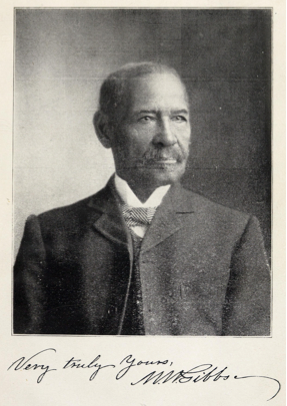
Mifflin Wistar Gibbs (April 17th 1823 – July 11th 1915) is recognised as the first Black politician in British Columbia. He was elected in November 1866 to Victoria City Council representing the James Bay District, a post he held until 1869.
Perhaps less well known is his relationship and experiences with the Queen Charlotte Coal Company, of which he was, by his account, a major shareholder. Gibbs was a Director of the company from at least 1866 – and had visited the mine site in that year. In late 1868 he resigned his company directorship to bid on, and win, a contract with the company to construct a wharf and tramway at the Cowgitz mine to enable the shipping of anthracite.
According to his autobiography “Shadow and Light” published in 1902, Gibbs departed Victoria for Skidegate Inlet in January 1869 and remained about a year on site.
The following excerpts relating to his stay in Skidegate Inlet working on this contract are taken from his autobiography. Some of Gibbs’ statements and observations are open to question, in particular those referring to the discovery of the anthracite deposit, the working environment (which appear ‘sanitised’), and the shipment of anthracite via the HBC steamer the Otter to San Francisco.
Beginning on page 101 of his autobiography, Gibbs describes how he got the contract, his trip up to Skidegate from Victoria, and his arrival:
“The only mine of importance in British Columbia previous to 1867 was at Nanaimo, where there was a large output of bituminous coal. In that year anthracite was discovered by Indians building a fire on a broken vein that ran from Mt. Seymour on Queen Charlotte Island, in the North Pacific. It was a high grade of coal, and on account of its density and burning without flame, was the most valuable for smelting and domestic purposes.
A company had been formed at Victoria which had spent $60,000 prospecting for an enduring and paying vein, and thereafter prepared for development by advertising for tenders to build a railroad and wharfs for shipping. Being a large shareholder in the company, I resigned as a director and bid. It was not the lowest, but I was awarded the contract. The Hudson Bay Co. steamship Otter, having been chartered January 1869, with fifty men, comprising surveyor, carpenters, blacksmiths, and laborers, with timber, rails, provisions, and other necessities for the work I embarked at Victoria. Queen Charlotte Island was at that time almost a ’terra incognito,” sparsely inhabited solely by scattered tribes of Indians on the coast lines, which were only occasionally visited by her Majesty’s ships for discovery and capture of small craft engaged in the whisky trade.
Passing through the Straits of Georgia, stopping at Fort Simpson, and then to Queen Charlotte Island, entering the mouth of Skidegate River, a few miles up, we reached the company’s quarters, consisting of several wooden buildings for residence, stores, shops, etc. At the mouth and along the river were several Indian settlements, comprising huts, the sides of which were rough riven planks, with roof of leaves of a tough fibrous nature. At the crest was an opening for the escape of smoke from fires built on the ground in the centre of the enclosure. As the ship passed slowly up the river we were hailed by the shouting of the Indians, who ran to the river side, got in their canoes and followed in great numbers until we anchored. Then they swarmed around and over the ship, saluting the ship’s company as “King George’s men,” for such the English are known and called by them. They were peaceful and docile, lending ready hands to our landing and afterwards to the cargo. I was surprised, while standing on the ship, to hear my name called by an Indian in a canoe at the side, coupled with encomiums of the native variety, quite flattering. It proved to be one who had been a domestic in my family at Victoria.”
The importance of a good relationship with the Haida was not lost on Gibbs:
“He gave me kind welcome, not to be ignored, remembering that I was in “the enemy’s country,” so to speak. Besides, such a reception was so much more desirable, as I was dependent upon native labor for excavating and transportation of heavy material along the line of the road.”
Gibbs then describes the character of the Haida who worked for him, exhibiting perhaps a more measured perspective on character and theft than that of Thomas Russell: Page 103:
“While their work was not despatched with celerity of trained labor, still, as is general with labor, they earned all they got. “One touch of nature makes the whole world kin.” I found many apt, some stupid; honesty and dishonesty in usual quantities, with craft peculiar to savage life.
Their mode of stealing by stages was peculiar. The thing coveted was first hid nearby; if no enquiry was made for a period deemed sufficiently long the change of ownership became complete and its removal to their own hut followed, to be disposed of when opportunity offered. If you had a particle of evidence and made a positive accusation, with the threat of “King George’s man-of-war,” it was likely to be forthcoming by being placed secretly nearby its proper place. But through it we see the oneness of human frailty, whether in the watered stock of the corporation or that of its humble servitor the milkman, there is kinship. To get something for nothing is the “ignis fatuus” ever in the lead.
My experience during a year’s stay on the island, and constant intercourse with the natives, impressed me more and more with the conviction that we are all mainly creatures of environments; yet all through the strata and fibre of human nature there is a chord that beats responsive to kindness – a “language that the dumb can speak, and that the deaf can understand.”
Commenting on the climate, Gibbs states: Page 104
“The climate of the island was much more pleasant than expected. The warm ocean currents on the Pacific temper the atmosphere, rendering it more genial than the same degree of latitude on the Atlantic. A few inches of snow, a thin coat of ice on the river, were the usual attendants of winter. But more frequently our camp was overhung by heavy clouds, broken by Mt. Seymour, precipitating much rain.”
This is on contrast to the harsh snowy weather experienced by Thomas Russell, who in his diary for February 27th 1871 commented:
“Gibbs was exceedingly fortunate. the Indians tell men [sic] they had only one fall of snow, and so light that it did not last a week. Had last winter been like this, he could not have completed his contract until midsummer.”
Gibbs described the construction project as follows: Page 104/5
“After being domiciled we proceeded with the resident superintendent to view the company’s property, comprising several thousand acres. Rising in altitude, and on several levels, as we approached Mt. Seymour, croppings of coal were quite frequent, the broken and scattered veins evidencing volcanic disturbance. The vein most promising was several hundred feet above the level of the sea, and our intended wharf survey was made, which showed heavy cuttings and blasting to obtain grade for the road. The work was pushed with all the vigour the isolated locality and climatic conditions allowed. Rain almost incessant was a great impediment, as well as were the occasional strikes of the Indian labor, which was never for more wages, but for more time. The coal from the croppings which had been at first obtained for testing, had been carried by them in bags, giving them in the “coin of the realm’ so many pieces of tobacco for each bag delivered on ship*. There was plenty of time lying around on those trips, and they took it. On the advent of the new era** they complained that “King George men” took all the time and gave them none, so they frequently quit to go in quest….”
*Robinson reported the Indians packing seven or eight tons of coal down to the beach when sampling it during his exploratory visit in June 1865 – see ‘QCCCo Appraisal of and Moves to Develop the Cowgitz Coal Deposit’ in this manuscript.
**Apparently this refers to the Indians having to work continuously during the construction of the tramway rather than having frequent breaks during the carrying of the coal from mine to ship during the initial sampling.
Gibbs then proceeds to describe the non-indigenous workers on site: Page 105:
“The nativity of my skilled labor was a piece of national patchwork – a composite of the canny Scotch, the persistent and witty Irish, the conservative, but indomitable English, the effervescent French, the phlegmatic German and the irascible Italian. I found this variety beneficial, for the usual national and race bias was sufficiently in evidence to preclude a combination to retard the work. I had three Americans, that were neither white nor colored; they were born black; ….”
This is in sharp contrast to Mine Superintendent James Landale’s 1868 description of these workers:
“In all my experience in Coal Mining I have never met with a more turbulent, disobliging, grumbling set of men; from the day we left Nanaimo till the day we left the island it has been one intermitting growl….”
Thomas Russell also had a very different experience with the various nationalities working with him…. certainly the ‘persistent and witty Irish’ in the form of Reily were anything but…
Gibbs hints at fairly rough conditions involving his workforce, alcohol and relations with the Haida women: Page 106
“The conditions there were such that threw many of my men off their feet. Women and liquor had much the “right of way.”
Although not expressedly stating so, Thomas Russell’s diary indicates that the Company during his tenure was essentially ‘dry’ - except for festive times such as Christmas when limited drink was available, or when Captain Knowles was supplying, and even then Russell’s comments refer to drunkenness amongst the Indians and sailors rather than amongst his men.
Gibbs commented on the completion of the work as follows: Page 106:
“Miners had been at work placing many tons of coal at the mouth of the mine during the making of the road, the grade of which was of two elevations, one from the mine a third of the distance, terminating at a chute, from which the coal fell to cars on the lower level, and from thence to the wharf.”
Thomas Russell was NOT complimentary of the quality of work done by Gibbs on the road. On Tuesday 10th October 1870 he wrote:
“There appears to me to have been a great deal of money uselessly spent. In fact in my opinion the only piece of work worth the money expended on it is the lower tramway, and that is not by any means a good workable road. The storage shute is not worthy of the name applied to it; the coal has a drop of 18 feet after it passes over the screen. Now it stands to reason that coal falling from this height must get smashed to atoms. Mr. Branch says there are 300 tons in it, but it is in a fearful mess with dirt, in fact it appeared to me to be a moral impossibility to clean it. The upper tramway is a shameful piece of work, I cannot think how a man like Mr. Trounce with his experience could have taken off Gibb’s hands as a workable road. It has caved at the last curve where you come in sight of the mine. From this point nearly to the mouth of the tunnel it is built on the side of the mountain and about 80 feet above the level of the creek. It appears to be pretty well cribbed except at the curve where it has caved. It is not cribbed at all here, but simply several long trees thrown down held up at one end by the root of a tree and at the other by a stake driven in; this stake only measures 4 inches in diameter, a match stuck in would have suited about as well.”
On Friday 25th November 1870 Russell remarked:
“The caved part of the road looks as though it will soon tumble into the creek; I wish Trounce and Gibbs were here now to repair it. I feel quite exasperated when I think of Trounce being paid $200 a month as Inspector of Contracts and accepting such a road as this, that has not stood more than nine months and is now impassable. He surely never could have inspected the work, because any man of common sense could have seen that a road built in this way would not stand.”
And, after expending considerable effort rebuilding the road, on Saturday 14th January 1871 he wrote:
“I wish Trounce and Gibbs were here now to work this beautiful road.”
Russell was also scathing of the amount of coal that Gibbs and Trounce reported as having been mined: on Wednesday 2nd November 1870: he commented:
“Branch was a long way out of his calculation when he said there were 300 tons in the shute, we haven’t taken out 200 tons yet and I don’t think there is much more than 50 tons left in it. I don’t believe it will yield more than 200 tons of clean coal. Should a ship come we will be in a pretty mess, but I sincerely hope she will not come for some time yet. Both Gibbs and Trounce must have given a false report as to the quantity of coal mined.”
Gibbs states on page 106 of his autobiography:
“After completion of the road and its acceptance by the superintendent and the storage of a cargo of coal on the wharf, the steamer Otter arrived*, was loaded, and despatched to San Francisco, being the first cargo of anthracite coal ever unearthed on the Pacific seaboard.
The superintendent, having notified the directors at Victoria of his intention to return, they had appointed me to assume the office. I was so engaged, preparing for the next shipment on the steamer.”
*This would have been in late October or early November 1869.
It is interesting to note that James Landale, who was the departing Superintendent, made no report on the first shipping of anthracite on the Otter to San Francisco in his report to the company written on his return to Victoria in November of that year. This is surprising as it would have been a very big deal for the company and a feather in his cap. The Otter also was an unsuitable vessel to bring a load of coal to San Francisco, and would have been committed by the Hudson Bay Company to its BC coastal trade.
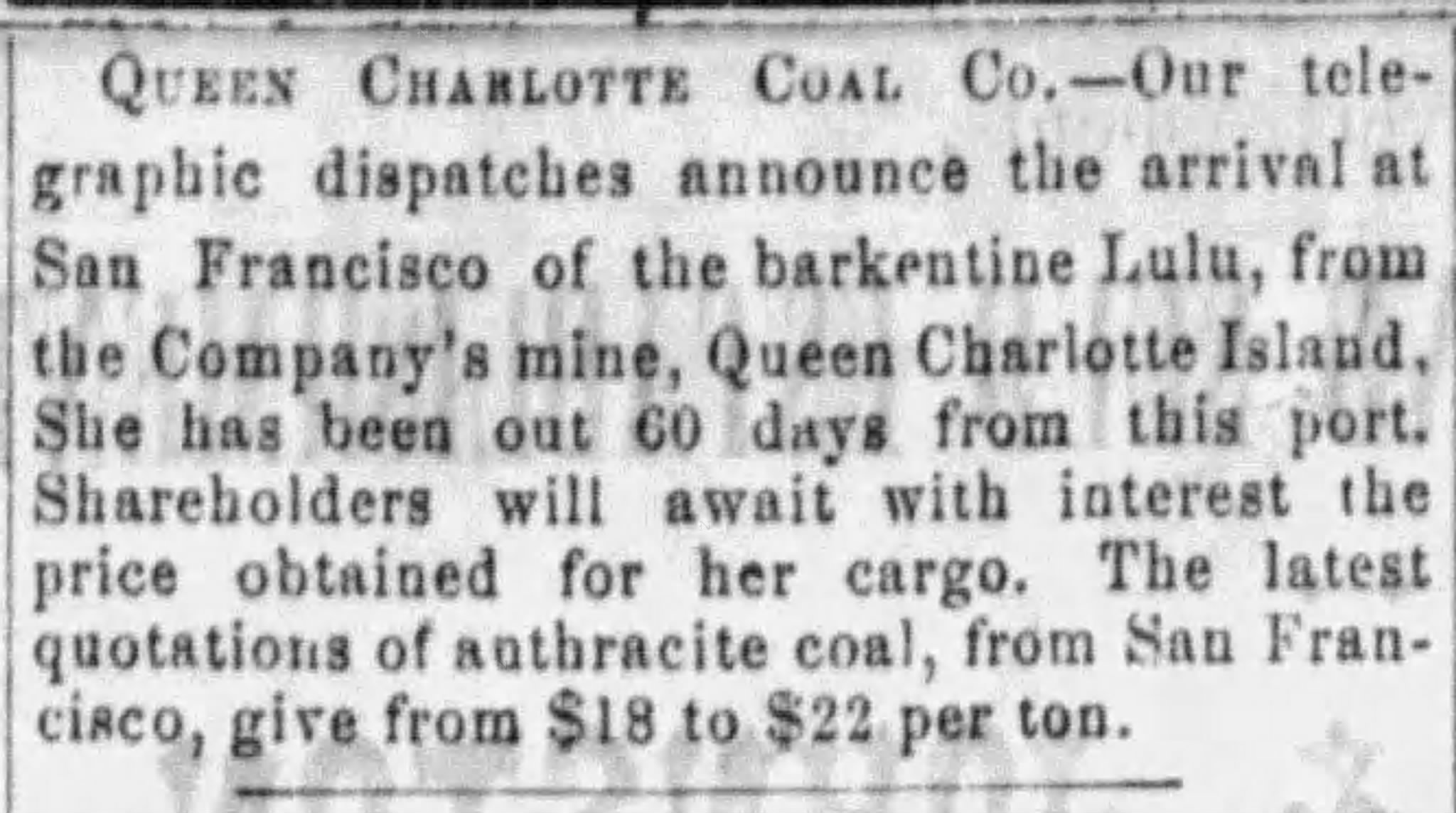
Did this happen? It appears not…. As per Thomas Russell’s diary, and reported in the newspaper, the Lulu was the first to carry coal from the mine to San Francisco - in February 1871
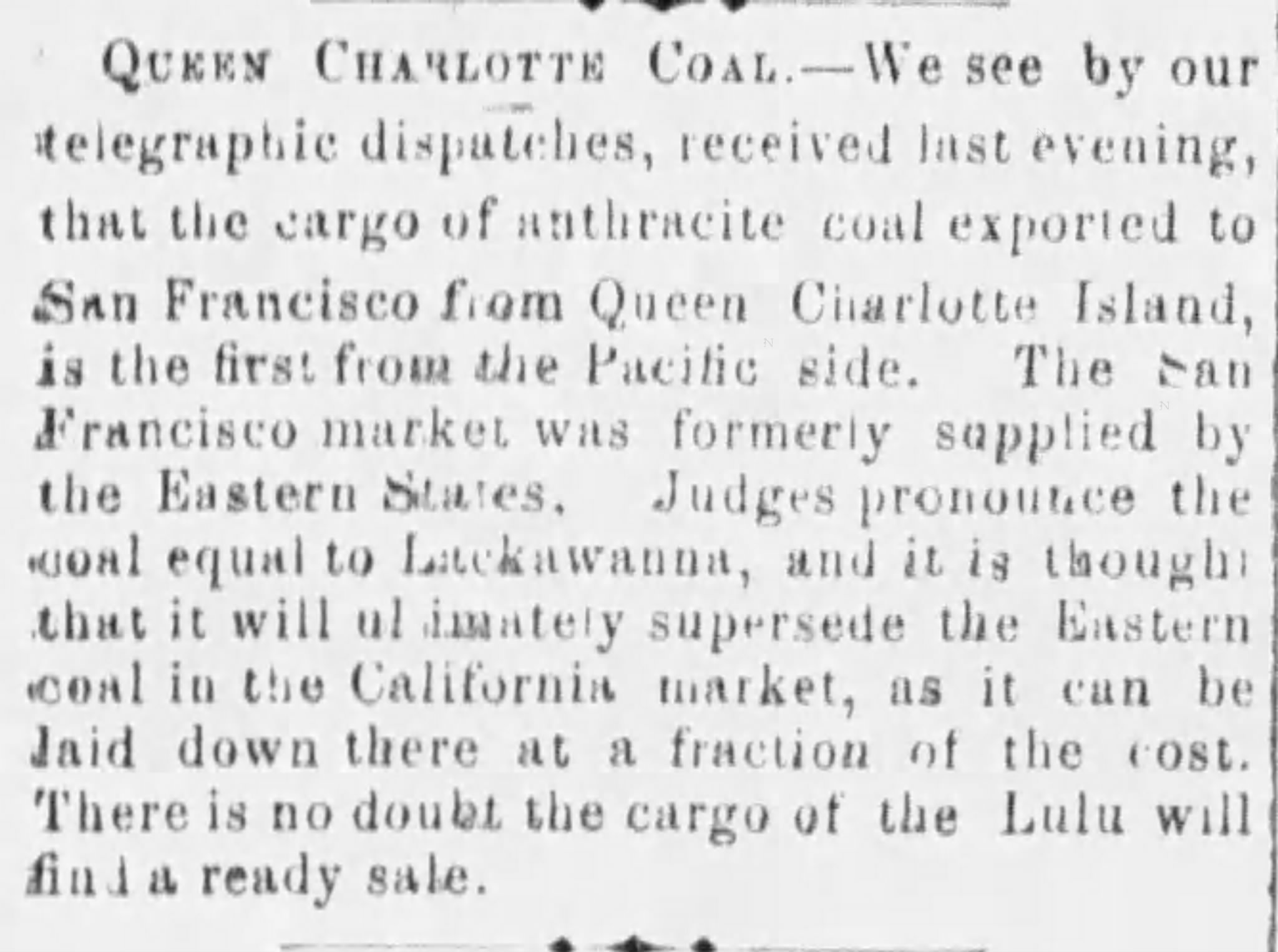
A newspaper article two days later indicates that was the first cargo of anthracitic coal emenating from the Pacific side of North America.
Something in common
One thing that Gibbs and Russell did have in common was a life threatening canoe trip.
Gibbs in his autobiography describes his experience in florid style: Page 107:
“My sojourn on the island was not without its vicissitudes and dangers, and one of the latter I shall ever remember – one mingled, as it was, with antics of Neptune, that capricious god of the ocean, and resignation to what seemed to promise my end with all things sublime.
The stock of oil brought for lubricating cars and machinery having been exhausted, I started a beautiful morning in a canoe with three Indians for their settlement at the mouth of Skidegate River for a temporary supply. After a few hours paddling, gliding down the river serenely, the wind suddenly arose, increasing in force as we approached the mouth of the gulf. The high walls of the river sides afforded no opportunity to land. The storm continued to increase in violence, bringing billows of rough sea from the ocean, our canoe dancing like a feather, one moment on a high crest by its skyward leap, and in the next to an abyss deep, with walls of sea on either side, shutting out a view of the horizon, while I, breathless with anxious hope, waited for the succeeding wave to again lift the frail bark.
The better to preserve the equilibrium of the canoe – a treacherous conveyance at the best – wrapped in a blanket in the bottom of the canoe I laid, looking into the faces of the Indians, contorted by fright, and listened to their peculiar death wail, “while the gale whistled aloft his tempest tune.” I afterward learned that they had a superstition based upon the loss of many of their tribe under like conditions, that escape was impossible. The alarm and distrust in men, aquatic from birth, in their own waters was to me appalling.
I seemed to have ”looked death in the face” – and what a rush of recollections that had been long forgotten, of actions good and bad, the latter seeming the most, hurried, serried, but distinct through my excited brain; then a thought, bringing a calm content that “To every man upon this earth death cometh soon or late:” and with a fervent resignation of myself to God and to what I believed to be inevitable; then a lull in the wind, and, after many attempts, we were able to cross the mouth of the river to the other side – the place of destination.”
Miflin Gibbs left the mine at Skidegate Inlet for Victoria in late 1869. He proceeded to liquidate the majority of his holdings and in 1870 returned to the States to join his wife and family who had left Victoria in 1867.
References
B.C. Black History Awareness Society. Stories: Earliest Pioneers (1858-1899): Mifflin Wistar Gibbs. https://bcblackhistory.ca/mifflin-wistar-gibbs/
Gibbs, Mifflin W. 1902. Shadow and Light: An autobiography with reminiscences of the Last and Present Century. 372pp. https://open.library.ubc.ca/collections/bcbooks/items/1.0348119
https://thecanadianencyclopedia.ca/en/article/mifflin-gibbs
https://www.biographi.ca/en/bio/gibbs_mifflin_wistar_14E.html