The Thornton
The Vessel
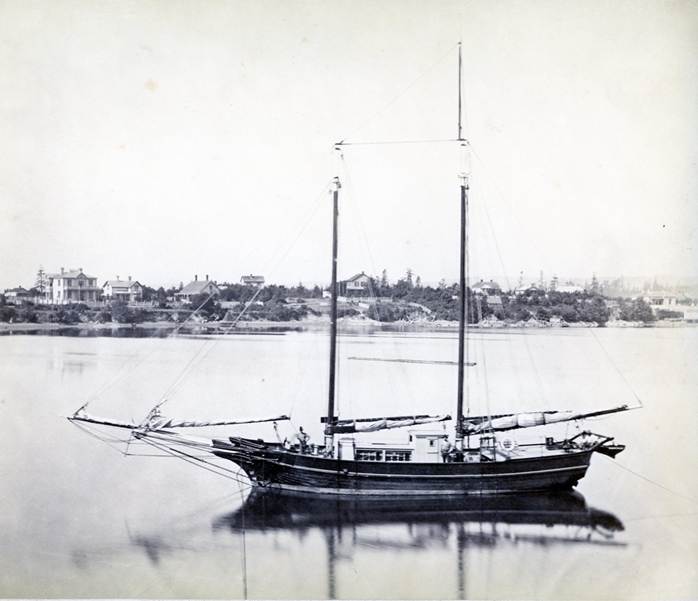
It is thought that the Thornton was built in the U.S. as a single masted sloop in the 1850s.
By 1864 Capt. James Douglas Warren was using the Thornton for trading in the waters of northern British Columbia, calling frequently at the major Indian villages on the Nass River and the Queen Charlotte islands.
In addition to freighting cargo, trading furs and dogfish oil, running whiskey and occasionally shipping passengers, Warren used the Thornton for sealing.
After taking Thomas Russell to the Queen Charlottes in September 1870, Warren had the vessel enlarged and refitted in 1871 as a two masted schooner – this is how it is depicted in Figure 1.
The Thornton was battered to pieces at Unalaska on Unalaska Island in the eastern Aleutian Islands some time after 1886 (Shipwrecks of the Alaskan Shelf and Shore (1992).
The Owner: Captain James Douglas Warren (1837 – 1917)
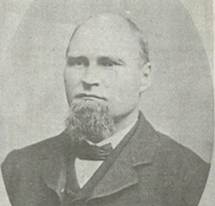
Captain Warren, owner of the sloop Thornton that brought Thomas Russell from Vancouver to Skidegate, was a mariner of some note who from about 1858 to 1871 with his sloop Thornton plied the coastal waters of British Columbia freighting cargo, passengers and trading dogfish oil and furs. He was also involved in illicit trading, having in 1867 been convicted of selling whiskey to the Indians.
In 1868 he and the Thornton were famously involved in a clash with Indians in the vicinity of Fort Rupert near the northern end of Vancouver Island in which 15 natives were killed and 5 wounded.
In 1871, with partner Joseph Boscowitz, he took up sealing and over the next 16 years built up a fleet of vessels which hunted as far afield as the Bering Sea. This partnership ended in litigation and financial ruin for Warren and in 1891 he left the sealing business.
Warren’s final business venture in the late 1890s was shipping passengers and supplies to the Klondike gold fields. He retired in 1900 and passed away in 1917.
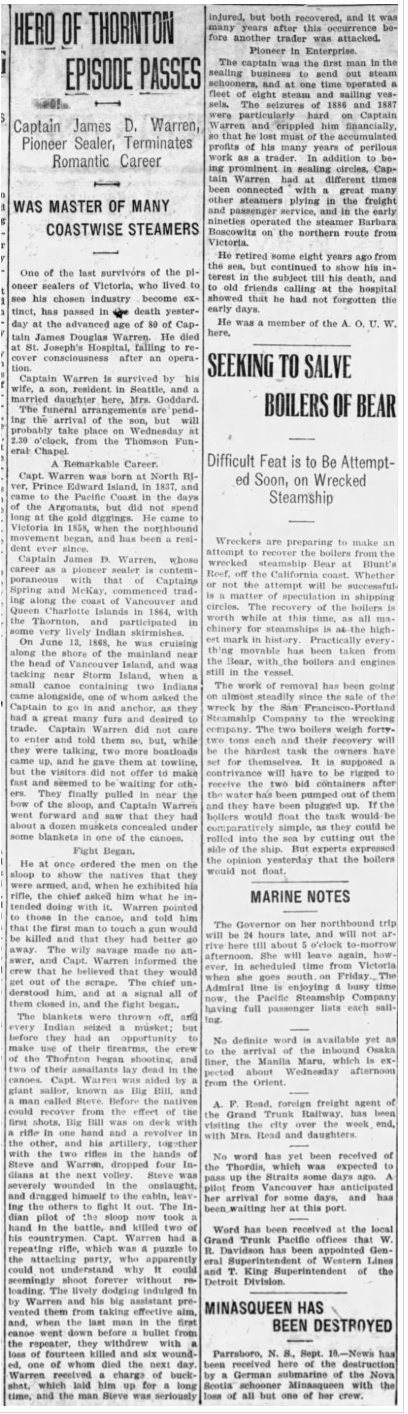
A comprehensive obituary in the Victoria Daily Times, shown in Figure 3, chronicled the career of this famous British Columbia maritime pioneer.
HERO OF THORNTON EPISODE PASSES
Captain James D. Warren, Pioneer Sealer, Terminates Romantic Career
WAS MASTER OF MANY COASTWISE STEAMERS
One of the last survivors of the pioneer sealers of Victoria, who lived to see his chosen industry become extinct, has passed in death yesterday at the advanced age of 80. Captain James Douglas Warren died at St. Joseph’s Hospital, failing to recover consciousness after an operation.
Captain Warren is survived by his wife, a son, resident in Seattle, and a married daughter here, Mrs. Goddard. The funeral arrangements are pending the arrival of the son, but will probably take place on Wednesday at 2:30 o’clock at the Thomson Funeral Chapel.
A Remarkable Career.
Capt. Warren was born at North River, Prince Edward Island, in 1837, and came to the Pacific Coast in the days of the Argonauts, but did not spend long at the gold diggings. He came to Victoria in 1858, when the northbound movement began, and has been a resident ever since.
Captain James D. Warren, whose career as pioneer sealer is contemporaneous with that of Captains Spring and McKay, commenced trading along the coast of Vancouver Island and Queen Charlotte Islands in 1864 with the Thornton and took part in one of the very lively Indian skirmishes.
On June 13, 1868 he was cruising along the shore of the mainland near the head of Vancouver Island, and was tacking near Storm Island when a small canoe containing two Indians came alongside, one of whom asked the Captain to go in and anchor, as they had a great many furs and desired to trade. Captain Warren did not care to enter and told them so, but while they were talking, two more boatloads came up and he gave them a towline but the visitors did not offer to make fast and seemed to be waiting for the others. They finally pulled in near the bow of the ship, and Captain Warren went forward and saw that they had about a dozen muskets concealed under some blankets in one of the canoes.
Fight Began.
He at once ordered the men on the sloop to show the natives that they were armed, and, when he exhibited his rifle, the chief asked him what he intended doing with it. Warren pointed to those in the canoe and told him that the first man to touch a gun would be killed and that they had better go away. The wily savages made no answer, and Capt. Warren informed the crew that he believed that they would get out of the scrape. The chief understood him, and at a signal all of them closed in, and the fight began.
The blankets were thrown off, and every Indian seized a musket, but before they had an opportunity to make use of their firearms, the crew of the Thornton began shooting, and two of their assailants lay dead in the canoes. Capt. Warren was aided by a giant sailor, known as Bill, and a man called Steve. Before the natives could recover from the effect of the first shots, Big Bill was on deck with a rifle in one hand and a revolver in the other, and his artillery, together with the two rifles in the hands of Steve and Warren, dropped four Indians at the next volley. Steve was severely wounded in the onslaught, and dragged himself to the cabin, leaving the others to fight it out. The Indian pilot of the sloop now took a hand in the battle, and killed two of his countrymen. Capt. Warren had a repeating rifle, was a puzzle to the attacking party, who apparently could not understand why it could seemingly shoot forever without reloading. The lively dodging indulged by Warren and his big assistant prevented them from taking effective aim, and when the last man in the first canoe went down before a bullet from the repeater, they withdrew with the loss of fourteen killed and six wounded, one of whom died the next day. Warren received a charge of buckshot, which laid him up for a long time, and the man Steve was seriously injured, but both recovered, and it was many years after this occurrence before another trader was attacked.
Pioneer in Enteprise.
The captain was the first man in the sealing business to send out steam schooners, and at one time operated a fleet of eight steam and sailing vessels. The seizures of 1886 and 1887 were particularly hard on Captain Warren and crippled him financially, so that he lost most of the accumulated profits of his many years of perilous work as a trader. In addition to being prominent in sealing circles, Captain Warren had at different times been connected with a great many other steamers plying the freight and passenger service, and in the early nineties operated the steamer Barbara Brockville on the northern route from Victoria.
He retired some eight years ago from the sea, but continued to show his interest in the subject till his death, and to old friends calling at the hospital showed that he had not forgotten the early days.
He was a member of the A.O.U.W. here.
References
Dictionary of Canadian Biography. Warren, James Douglas https://www.biographi.ca/en/bio/warren_james_douglas_14E.html
Maritime Museum of British Columbia https://mmbc.catalogaccess.com/photos/23124
The Nauticapedia: https://nauticapedia.ca/dbase/Query/Shiplist5.php?&name=Thornton%20(I)&id=15622&Page=1&input=Thornton